Showing posts with label sance. Show all posts

Friday, May 18, 2018

Folk magic uses of Green Pepper

Many know and use hot or red chiles in their workings. However one day a couple years ago a product caught my eye at a mexican botanica store, a Green Pepper Novena Candle. Peppers are called pimente or pimenta in spanish and closely in other languages, but they are not all spicy. An Anaheim, Ancho, or Poblano variety, are less spicy.

Hot pepper more aggressive, commanding and protective and add hasten or to quicken a spell, but can cause explosive relations: too much passion or quarrel, burning akin to needles or a thorn. As I have seen them added to love spells cinnamon might also be a better option as peppers are bitter, acidic fruit.

Peppers are part of the nightshade family of plants like potatoes, tomatoes, eggplant and the deadly often poisonous belladona herb. People used to beleive tomato was poisonous, and potato if green or gone bad can kill people.

Green or Red Bell peppers can be used in Desire work for love as they are sweet. Usually a persons object of affection or partners photo are placed between the two cut halves, then fixed shut. The vegetable is used as a spell container or jar.

I have on good authority in the area of southern Texas to Mexico they are fixed with chile, cinnamon, ant hill dirt, and honey to make them think of you. Then wax is used to seal them shut of the desired color.


Peppers cleanse and absorb negativity, undo jinx, used against evil, evil eye, witchcraft or spells.


I have also seen a green pepper floorwash or they can be placed at the doorstep to cleanse and maintain the home or business. To make your own you can boil a few sweet peppers, and then blend them or with a hand mixer diluted with the water, then strain.

I have also seen a green pepper bath!
Hot peppers are usually passed over the body as a more agressive form of cleansing in many native traditions.
They can be burnt in a mixture to dispel evil along with other herbs.
Of course other preperations such as oils, herb mixes in mojos are used.

I seen a lamp to the Lwa Dantor with sweet red pepper for love, money, to break obstacles. Giving her pork or hot peppers will make her "hotter" and more dangerous to work with, especially for the untrained or unassociated.
For bell or sweet peppers color is important, I seen green and red peppers floating in a lamp for her. Green is close to blue in spectrum. Some also use yellow, I assume this lamp was to sweeten the Lwa or was for love or green some use as a color intended for money. I have seen colored powders used for her veve in Haitian Vodou with blue yellow red and green colors.

                                                                                                              S7X


Friday, May 4, 2018

Lineages of Sanse

There are many lineages of Vodou such as "Haitian": Asogwe lineage
and other lineages in Haiti and the Dominican Republic such as 21 Divisiones and family groups.
There is also New Orleans or Louisiana Voodoo and West African Vodoun from which the lineages in the new world originate and arrived from via the slavery diaspora.

Little known is Sanse a Vodou lineage through Puerto Rico which is more spiritualist and deals more with the dead in its approach. Within the other listed traditions there are also differences in how things are performed and this is not because there is no unity of thought rather that the way that things are done have some similarity and an underlying reason for choices that went into the way these lineages were perserved. For example I have learned from some people in "Dominican" Vodou 21 divisiones that their practice is baptismal and more saint based in their approach than others in the same umbrella tradition. Those familiar with these traditions know some things never change and others can be done correctly in different ways that make sense. Most of these traditions are family based, while others are a mixture of family and temple in organization. There are Lwa that are more concerned with individuals and others with community and family groups so that there are going to be differences in spirits served from one region or locale to another, which also influences focus and way the group operates.

When it comes to Sanse we also see ourself as organized by lineages of spirit groups. Our house has pantheon 7 chiefs, whereas others have 21 divisions of families of Lwa or chiefs that oversee a group of Loases. Within the 7 chief lineage the 7 chiefs served can again vary from one house to the next for example.

Ours is Candelo, Tindjo Alawe, Ghede Limbo, Metresili, Ogun Balendjo, Beli Belcan and Legba.
They all have spirits under them. Wheras other houses may have different Ghede jefe chief or Lwa Anaisa or Marta the Dominator instead of Metresili to head the female spirits in general. Gran Solier is generally viewed as head of them all the chief of chiefs.

The candidate entering Sanse would receive these 7 by lineage and also any Lwa insistent within their spiritual frame. Other Lwa can be received at a future date. Some choose to only baptise if they do not intend to or serve as a horse for the spirits to come in preliminary ceremonies to connect them with their own court of spirits. This is partly where the idea of the 7 african powers came from, mistakenly taken to mean the Orishas
example from Sancista Brujo Luis
21 jefe:


Sanse includes the spiritualist tradition of Espiritismo, some are cruzado with african elements and some indigenous elements, whereas others are more classic, minimalistic or european spiritist in their tradition. Usually within Sanse there is the coronation of the or crowning of the dead. Some such as our house and the influence and houses of Ocha/Santeria it is a joining of the consciousness with a main spirit guide with a baptism ceremony, somewhat like the Lwa when Vodou spirit points are received after a lave tet headwashing. Others see it as recognizing your spiritual frame and having a spiritual party.

As described many houses of family Vodou and lineages are baptismal in their entrance rites only. And that also lends to the perceptions about Sanse being a family baptismal tradition, with some minimalist in their spiritualism. This can lead to misunderstandings about others practices and more ritualistic traditions. Where mixes of people came together, the type of influences recieved in the mix varied a bit, as some retained a more Vodou current from the island of Hispaniola (Haiti and the Dominican Republic) in working with and serving the Lwa... whereas other focus these spirits as soley representatives, the dead emissaroes or messanger dead of the Loases and Orishas. We certainly work the Lwa but recognize the influence of messangers and primarily are spiritualist in our group in dealing alot with the dead and due to our shared congo influences.


Saturday, April 7, 2018

Oral hygiene, the mouth, divination and working with the dead

Spiritual hygiene such as cleansings was given an introduction in a previous blogpost.
As well another blogpost covered how the dead can affect a living persons physical health.

Looking at the liver of a sacrificed or animal killed to divine a physical illness, often the entrails or gut and liver of the animal was looked at. This often would show negative energy removed from a person or divinatory information. Likewise the gut, liver and intestines of a person are often affected by negative energy.
Bowels have been related metaphorically to lower realms or "hell" where there is the stench of sulfur, feces/excrement and to lower energetic frequency.

The other area is the bones and teeth related to saturnine aspects of the dead, the material and death...a skeleton.
Omens such as dreaming of teeth falling out is said to portend a death in the family.

The mouth and teeth are related to digestion and our ability to nourish ourself for health and life to eat to take in energy. If we do not eat we do not live and will waste away as if something was feeding on our energy. As well as to express and defend ourself "tooth and nail". We may not be literally biting people but if we look at symbolism and how that plays out on energetic realms such as with totems and the use of animal parts in folk magic such as horn and fang in protection and warrior traditions, it also relates to being a human/animal in warfare or fight and flight.

With divination in the ATRS (african religions) many refresh their shells used for divination with coconut water and cleanse the instruments with cigar smoke. The devices are instructed that the mouths of the shells, or tarot cards used speak truthfully and accurately. This is done in some Yoruban faiths because misfortune causes the divination devices to be inaccurate unless they are cleansed. One Espiritismo Cruzado prayer of tobacco, asks that may the spirits that speak through the sacred smoke of this tobacco... and through the spiritual fluids communicate as such with purity.

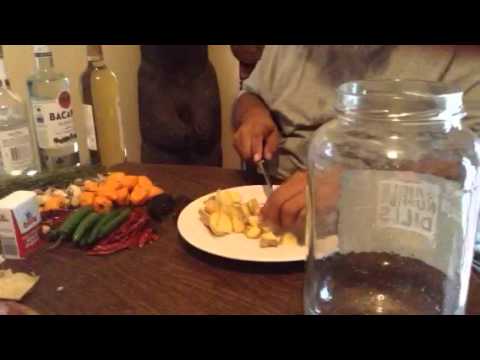
In Palo, a communal drink of chamba is used for several reasons. One being practical to decrease illness by cleansing the mouth, sickness believed to be caused by bad spirits. The drink contains antimicrobial substances like alcohol/rum steeped with ingredients such as hot peppers, ginger and garlic. Some recipes contain bone powder and sticks from different species and is made or human consumption or for feeding items and spirits only. It is buried in the earth, a tomb to absorb the energies of the universe and the ground. Chamba again has many applications, but it is believed the dead can cause cavities and residue from their energy can rot inside holes in the teeth. Coconut products were also possibly used as daily routine in personal care, such as with oil pulling in the mouth which is spat out after swishing for minutes.

Despite not having modern dentistry many areas of the world with tropical climates did not have as many dental problems as we see in modern cities. Natural products like these were used in traditional medicines and preventative remedies....
Still, it is a good idea to be up on your regular care and appointments.

Chamba drink is swallowed and is also a form of internal cleansing against witchcraft affecting the body, or if injested in our food that someone laced with witchcraft. In days of slavery poisons, insects, dirts etc were often put in rivals and slavemasters food and drink. Popular today is a love spell where women put heir menstral blood in their mens food like spaghetti sauce to try to dominate them and ensure fidelity. So be careful about who you accept food and gifts from! This is why some will not accept or have prohibitions on leaving drinks around especially dark drinks that can mask what people have put in.

My post on Mama Juana describes a Caribbean native medicinal drink made to also cleanse the body of witchcraft as well as detox the gut, liver and gallbladder area, and can help many disease process. Detox of the body is a good idea in general to help elevate your energy, increase spiritual faculties and health.

You can also do this with coffee fixed how you like or dandelion root tea sweetened with honey, as it is bitters and a digestive tract cleanse. It is dark in color and therefore is good for "banishing" or cleansing. Speak and pray over it to intend to cleanse your digestive intestinal organs and body, to remove any negativity, sorcery, witchcraft and stagnation before drinking. To make a ritual of it light a white tea light candle along with your beverage.

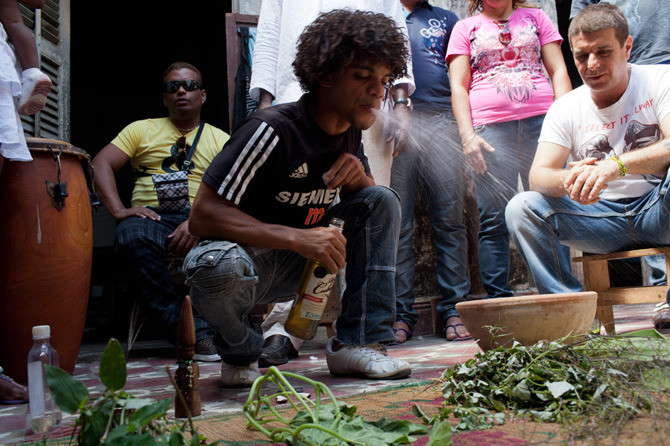
Myself I spray rum with my mouth to clean areas and feed and connect with spirits and use my energy, there is a great supply of personal power of Ashe upon the saliva. Often times sweat/scent or unbrushed mouth has a persons energy connected to it so spirits can find you faster with Vodou, or with bad spirits, which is why we change our clothes, linens and do spiritual breakings and cleansings with worn dirty clothing.

But also make a point to brush my teeth before misa or when I know I will be speaking during spiritual readings so that I too may speak via spirit and work cleanly and speak accurately to remove obstacles to our work with higher entities.

The mouth is a gateway or portal. The holy spirit and gift of tongues are mentioned many times in the bible, and about the mouth of God, and even in genesis how the spoken word leads to creation or manifestation from the spiritual to the physical world. The mouth is an opening and energy center of the body, blood circulation under the tongue supplies ready energy to the breath, along with the lungs during speech to create a vibrational current, and in the use of breath in spiritual works to charge and awaken such as blowing Vodou powders to the 4 winds.


For what is the language of the birds? It is not literally understanding a bird chirping..hahaha The birds carry our prayers to the spirits in our ceremony, the feathers and wings are metaphors of airy spirit flight.
It is to speak and communicate with spirit(s). And there are much deeper secrets than these.


Mar 16:17  And these signs shall follow them that believe; In my name shall they cast out devils; they shall speak with new tongues;
Act 2:3  And there appeared unto them cloven tongues like as of fire, and it sat upon each of them.
Act 2:4  And they were all filled with the Holy Ghost, and began to speak with other tongues, as the Spirit gave them utterance.
John 20:22  And when he had said this, he breathed on them,and saith unto them, Receive ye the Holy Ghost:
I will also wash my hands if a bath for some reason was not performed with florida water.
There are certain Lwa who will not touch earth in their horses, nor interact with the community unless strict cleanliness has been observed.

Hope that these words have been illuminating for you,
until next time,
Sancista Siete Enruzhiladas


Saturday, November 11, 2017

Getting started in Vodou & altars: non-initiates & beginner advice


Get a reading to discover some of your Lwa

The very first and respectful thing to do, if you are interested in the religion of Vodou is to get a reading from an initiated priest to look into your spirits, the Lwa of the religion.

 It should be a reading from a priest in the branch that you are interested in, or possibly want to be initiated in yourself eventually. This is because different houses and branches have different spirits, and these will step forwards when you are read. They may also share some in common. Depending on your bloodline some of these spirits may have been there since birth. In family Vodou they pass down the same handful of Lwa. You must look at obtaining this guidance as joining another family or through a different group. Some say at least our head spirit was there since birth. I do not personally know if this is true. If we do not have these spirits through bloodline, they can call us, but again we are joining another family, being adopted in. This is why if you go to different priests in different families or branches your reading will not be exactly the same. There is no prohibition to any race or sexual orientation from entering Vodou.
Tarot readings are popular, but many devices may be used, and such as personal revelation or sign given to the priest by the Lwa for you.

If you get a reading from a Haitian Mambo, and then from a Sancista or Papa Boko, the way in which the spirits come across or step forwards for you can differ due to lineage. If you stop your guidance or relationship under the priest, then your spiritual connections may weaken, unless you become a full priest yourself. Because the connection may be broken by family. This is not DIY do it yourself, mix and match practices.

It is widely held that your met tet, main Lwa or Orisha cannot be known with certainty until you initiate. In 21 divisions, one Papa Boko states there is a reading qi/ki Lwa or star reading. But we do not determine head spirit in Sanse or Haitian Vodou, asson lineage before the ritual date. We may suspect who this is, but it can also change.

The Vodou are not a personality type. Just because you have La Sirene in one tradition does not mean you have Yemaya in another. They are not just archetypes or forces, they are beings. They are not like pat descritpions of greek gods like the god of war or goddess of love. Often times they are a whole group type of family of spirits. One spirit can have different paths or ways they are served that you may have one and not another type of Legba. But in our tradition they would be under the chief Papa Legba.

The Lwa belong to the religion and cannot be separated from their people and religion by magical approach alone. The African spirits do not belong in newage, Wicca or ceremonial magic. The same argument can be made with other indigenous traditions, and fake native American "shamans". Vodou is a living surviving tradition which does not need one person to make changes. And should be respected as such for the sacrifices made. It does not need reconstruction. Its spirits have not gone cold, or as inactive. They are very able to enact change on earth, and as elevated as some are, are not lofty and removed.

Vodou is a religion and not a system of folk magic and curses. Many people do not know what it even is but I am sure only think that they do. Vodou does not have a pantheon you can pick and choose from at will. You either have a Lwa or you don't, especially in the beginning. When you work with other spirits you do not have, it can create problems by making your other connections weaker and problems in your life. You may have problems with bad spirits due to imposters and evil dead masquerading as these spirits. Other spirits who are good can also use the image of Lwa such as guides and ancestors.

Once you have discovered some of your Lwa, you can get direction with what they may require, and have ongoing strengthening of relationship. Initiating is not the beginning or ending of practice, but guidance is absolutely key. You cannot learn from books or the internet. There is alot of bad information out there written by outsiders. the spirits themself have indicated how they want the tradition, and it is not a solitary personal path via psychism, it is a community religion. Any information from alternative sources should be checked with a reputable priest. A relationship with a priest will help prevent alot of problems and also be a resource to help with ones, instead of problems or desperation being your first introduction. You have already shown respect, and respect to the religion and spirits. Vodou is an oral tradition, that practitioners have dedicated their life to.

It needs to be understood that this is a lifestyle, that you need to understand certain cosmological concepts, and become acculturated to the people and culture you wish to approach.It cannot be what you want it to be. This is where entitlement and appropriation come in, a form of bigotry and racism. So be polite and attempt to learn the way things are. Ask about information from several priests to get a better understanding.

Personally I think that Papa Legba can be approached respectfully by all. However do not confuse that with practicing the religion. It is very common to have a visit from Papa Legba or the Baron in the beginning in dreams and such as they are introductory spirits to communication with other Lwa and the dead.
                                                                   
                                                  Simple offerings can be given to Baron Samedi at the graveyard gates to introduce yourself, state your full name and that you want to start a relationship. Next visit state your full name and ask for protection if you enter the gates. The ghede can be tricky to work with as they are the radical dead albeit accessible, they are not your ancestors. Cleansings can also be done on this point. His number is 9.


Papa Legba is a very patient and forgiving spirit. However if disrespected will close communication and opportunities in your life and will not be able to catch a break. Unfortunately due to AHSS and Hollywood the image of the Baron pops up leading to misunderstandings. A simple offering can be given to the crossroads or behind your front door. DO NOT put Ellegua stuff to him, they are 2 completely different spirits. Ask him to open the way to good and close the way to bad, the same as you did to the Baron after your first introduction. His number is 3 and 21. You can simply even draw a cross with cornmeal or cascarilla (less traditional) for him, and place his offerings apon it once he has been called and saluted.
We use different mixtures of natural substances and powders to actuallly draw veve than just cornmeal in the religion.

Ancestral Practice

You must start with you ancestors before you try to work with the higher spirits in the African Religions. You may set up an ancestral altar, but even this may have issues, bringing forth issues with the dead and ancestral issues, which are of benefit to get guidance on. The altar is a microcosm of your life, and a portal. Your ancestors can be displeased, and as a presence interfere and cause blocks in your life. Alot of people when they have problems in their life do not identify it with their spiritual practises. Whatever you do or do not do on your altars will have consequences or play out in your life.

Non-initiates

As a non initiate you should not offer any readings, services or teachings regarding Vodou, Lwa or the Orisha. This is disrespectful, counterfeit and is the job of the priests to provide. It is scamming and going to create problems in your, your family, and clients lives. These spirits are not found in hoodoo. Some do know better and do not care, others get taken advantage of in their ignorance. You should not make objects such as dolls etc. If you do make it clear it is an art piece only without spiritual value. They can be used or prepared by a priest if you want that to happen but consult first as the spirit may not like the figure. The priest is the bridge to the community in a community religion, not solitary. In all indigenous ways, there was a system of apprenticeship. The first step is humility and respect.

You should learn from history and ethnoography instead of buying spell books. You should learn about worldview and concepts behind why things are done. Do not copy other peoples altars and work. It can be an incorrect interpretation that you are assuming, or something personal to someone else that does not apply to you. You should start learning about spiritual hygiene, and keeping up on your spiritual baths and house cleaning spiritually. To know it is one thing, to practice and live this way is another. Vodou is a way of life. Spirit affects and is revealed in all aspects of life.

Try to go to community events near you as much as possible. 
It is true that many on the islands are not initiated. But they come from family lineages and many associate with temples for larger issues or are called to priesthood.
A person of a different country and culture lacks that connection otherwise.
Be helpful, respectful and contribute, this way you can observe, and put in service. The spirits will familiarize with you. If this is not possible then continue to work with your priest in terms of items that can be made for you and advise. By purchasing these small to large things, you can have experiences to see if its the house or religion for you.
It is a reciprocal relationship, and you will learn more than buying mostly useless books.

However there is one practical beginning book I can recommend in Haitian Vodou by Mambo Paula Wedo called: Ayibobo
You can learn how to do a basic salute and libations to the Rada Lwa.
Another I can recommend is Mama Lola, many priest recommend this experiential book.
No book will tell you how to practically practice, or has silly ideas or hoodoo and folk magic if it does. It will not supplement your connection to the spirits. You should read suggested books, and always check with your mentor or priests about the information. Most facebook groups are terrible, try to join one and take the advices only from priests not personal opinions.


There is certain way to use veve and they denote lineage, like a calling card or pass. As such you should not use a random one off a book or the internet, unless given by a priest to you. A priest can pass on certain advices, requests and working you can do that are prescribed by the spirits. Readings, also called "lessons" can confirm or deny your own dreams and spiritualism

The Lwa come in "possession" and the spirit administers to the community, its not just spells at home, this is the religion.

The Lwa expect certain things, songs, gestures etc. And the priests are trained to manage the situation. The priests know exorcism. This is real Vodou....not pins in a doll by a self ordained person and such "sorcery", candles or honey jars.
This truth may make some unhappy due to inconvenience, but there are no shortcuts or backdoors.
Work is done with and under the spirits. People will lie to you or do not know what they are doing are likely to rip you off or lead you astray and waste time, the blind leading the blind. Once you get the same answer from several priests stop asking, do not continue to ask around until you get the answer you want or like.
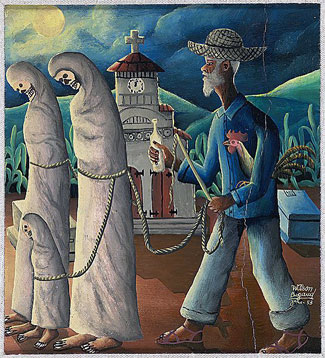
Zonbi
A good priest will have good character. Noone is perfect but they should have a sense of nobility in being trustworthy and be able to control themself and not have knee jerk emotional outbursts,

Vodou altar

You should not set up a table without guidance for the reason stated above. To work with the Lwa that you actually have, under an initiated priest. Be open to the spirits you are guided with and not just because you want this or that Lwa. Just because Erzulie is known for love, does not mean that many other Lwa cannot also perform this work, or want to perform this work for you. Once you have an idea of some, with guidance you can set up a prayer table. This is not the same as the priests altar who have received the spirits in ritual, or have been passed down in an unbroken family lineage.

Certain spirits go specific places, some do not like each other, certain things must always be present. 

Buying a statue is empty plaster, there is no spirit there. A priest does not need a veve or statue to have contact.
People need to start thinking spiritually and not materially.
When you become an initiate it is like an attunement internally, a foundation: pwen or a spirit point. Which joins the body and head to the spirit.
If you buy a statue or a doll it must be blessed or baptised by yourself at least. And it can be a gift or an object of meditation but do not mistake it for the Orisha nor Lwa, nor spirit guide. Do not buy all the Orisha or Lwa oils baths and candles from the botanica, they make a nice gift to the spirit but they are not traditional. Using these things all together is not Vodou. The religion or spiritual tradition of Vodou has its own traditional recipes for making baths and lamps that are passed down and not full of synthetic ingredients. If they are used they are usually added to other things, such as a fixed candle or lamps with other fresh herbs or natural oils. We do use many spiritual waters and perfumes.

Of course dolls and statues or pictures can be prepared as pwen. No pwen: no license or attunement with the spirit.
Spirits cannot be bought. Bought Pwen "Achete" are usually but not always contracts facilitated by the priest. They are the dead, earthbound and intranquil, djabs/demons/devils or Petro spirits usually for hire. They are not usually hereditary.

They must be paid, fed and worked with a certain way or your life can become a disaster.
The rada Lwa need to be fed, and given exchange, but again you either have them, they are interested or not.

Others say no altars in a house that is not really yours or is not a family house. Some altars are set up not to be moved and they are there for life. This is because in a traditional African shrine, the land and land spirits are familial, ancestral. Where you are born and buried are linked to family lineage in the root branches connected to your family lines of spirits.

With a prayer table you've created a sacred space designed to focus your faith and attention on your practice. It is intimate, singular and particular to you and it represents your understanding of your relationship between yourself, and your Lwa trhough the lineage you have approached. It is invested with a tremendous amount of your personal spiritual power, energy or ashe. Offerings and prayers can be given, but they are only vested in you, and not do work besides protection and perhaps occasional small petitions. Big work requires more engagement. and not a simple offering. Do not promise them anything you are not able to fulfill. They can be bargained with possibly.

An altar, on the other hand, has been specially prepared and inhabited by the Loases it was made for. It is also indicative of your relationships with your spirits but is reciprocal. The Vodous are actually in the altar and do more than just receive offerings, honor or veneration. It is working with them instead of only serve. Many confuse the word honor or serve with working or petition. The priest only has or can install this altar to a spirit in person.

Sancista 7 Crossroads


Tuesday, May 23, 2017

Cantos para misa espirituale, learning songs for spirit guides, the dead and misa part 3

La Gitana: The gypsy
Hermana Rita gitana mia hermana Rita dame bondad llevame a tu santurio
a buscar la caridad
Deidad de amplias luces son tus cartas prodigiosas ahi tu lees los misterios para dar luz y progreso cinco flores yo te dedico cinco flores de humildad buscando que tu me brindes esperanza y caridad GITANA gitana pura gitana gitana inmensa librame de inquietudes librame de los lamentos Gitana de mis amores bendiceme ay gitana gitanita bendiceme bis pero gitana de mis amores bendiceme ole con ole gitana ole con ole olee ole con ole chiquilla ole con ole y ole ole con ole gitana ole con ole y ole OLE Gitana de mis amores bendiceme ay gitana gitanita bendiceme Hermana rita gitana mia bendiceme


Sister Rita, my gypsy
Sister Rita, give me goodness
Take me to your sanctuary
To seek charity
Deity of ample lights
They are your prodigious letters
There you read the mysteries
To give light and progress

Five flowers, I dedicate you
Five flowers of humility
Looking for you to give me
Hope and charity

Pure gypsy gypsy
Immense gypsy gypsy
Free of worries
Liberate of lamentations

Gypsy of my loves, bless me
Ay gypsy little gypsy bless me

But gypsy of my loves, bless me

Ole with ole and
Ole with ole olee

Ole with ole child
Ole with ole and ole
Ole with olea and
Ole with ole and ole OLE

Gypsy of my loves, bless me
Ay gypsy little gypsy bless me
Sister Rita my gypsy bless me
Sancista 7 Crossroads

Wednesday, April 5, 2017

Charity

Charity
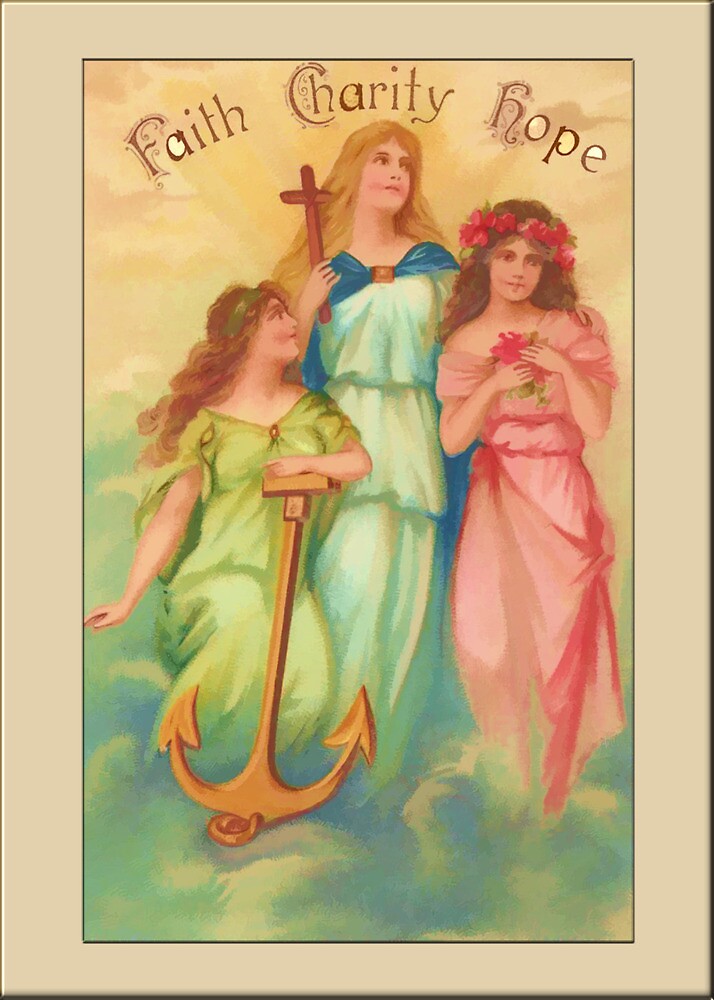
Charity is one of the highest principles held in Espiritismo of hope, faith and charity.
They are given prose in Allan Kardec's book of selected prayers and have interaction. They are both masonic and christian principles. They are symbolized by the heart, anchor and cross, as well as the 3 marias ( tres marias) or graces/muses as virtues.

This symbol put together, some use as a symbol of Sanse. The cross is of a man and the world tree, the earth and sun or faith. The heart is central of the sun or solar plexus and heart and light. The anchor is of hope,what keeps us grounded, and has the lunar and watery symbol. As in the tarot card the star, these are guiding principles linked to destiny. The hebrew letter to the star tarot card is translated as"hook", because man or souls are viewed as fishes. Such as in the bible the disciple and fisherman Peter/Simon became the fisher of man and the rock or foundation of the church as the first pope. The spiritual forces always seek towards man just as much as we look for guidance and light. As a seafaring people, they would navigate by the light of the sun and the north pole star. They even had an early navigational device known as the cross staff.

Charity means love of your fellow man like philanthropy, but many people think of it as donation to institutions, and charitable work,
Is there a higher tenet than love?
It is said that God is love.
Charity is also action, of charitable words, not speaking bad of others in gossip and undeservedly.
Of loving and helping each other.


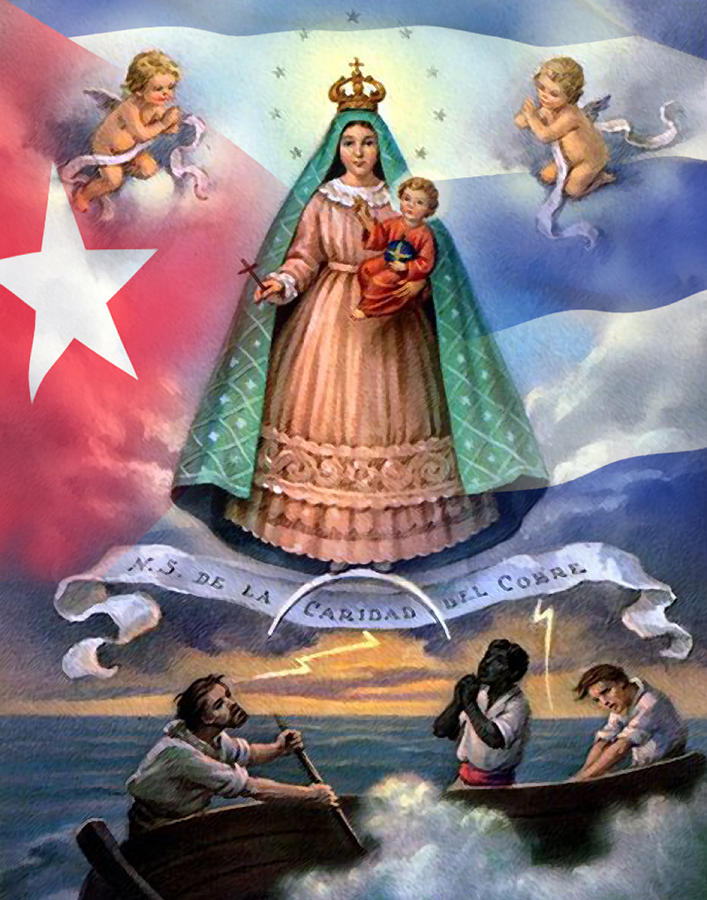
Caridad de Cobre, the Lady of Charity
Many people think that Oshun, syncretized with the saint image of Lady of Charity or the yellow Caridad de Cobre is charity, but this is not so. Oshun is known for love, happiness, sensuality, riches, and luxury as well as foresight.The Saint of Charity is the patron of Cuba, and some use the blue one also or both colors, but that means something different in our lineage. The yellow one can also be used for the Lwa Cachita Tumbo but some use an Indian woman, whereas the blue can be used for La Sirene or Yemaya, but they also use the saint image La Diosa del Mar (goddess of the sea). We understand the saint is not the Mysterio Orisha or Lwa. One of the paths of Oshun is a chieftess, more of a native Caribbean woman. Cachita Tumbo is like Oshun as a river spirit, but many also mistake her for the female Lwa Anaisa Pye, whose name means little yellow or golden flower. She also has a path of a native woman.

The tale of how this saint came to be is very interesting. The men in the boat represent the three races which mixed and became Cuban: European, African and Indian or mixed ethnicity. The men were out harvesting salt, and were caught in a storm off the Caribbean island. Fearing for their lives they began to pray. Then the little statue on a board with the epitaph "Lady of Charity" washed towards them, and they brought it ashore. Thus Charity became linked with Faith, and is a deeper theme explored in the Prayer of the Shipwrecked. And also the Prayer of the lighthouse as the guiding light to both incarnated and disincarnated souls, The lighthouse is a metaphor for our centinela or main spirit guide, to guide us, and usher in other spirits.

In Chief Miguel Sague's book Canoa or "canoe" he tells of a slightly different version of lore, with more of the native or Taino history. Whether or not this is myth, of visions, or dreams in the telling, the cultural meaning comes through clearly. The statue is a replacement to safely hide the spirits of the land before colonization; of an earth and river creatrix: Atabey and Atabeira. Like the Taino Cemi spirits in stone, this statue mysteriously moves places, and reappears eventually back at the little chapel on top of a copper mine. Cobre in spanish means copper, and as many people lost their lives in the mine, she was looking out for them and guiding them with her light.

Saint Sophia or wisdom is told as their mother, Sophia is "Gods wife" as Wisdom herself the Ama or Asherah. From which we get the word philosophy, or the love of knowledge and study. Some see her as a Magdelene, rumored wife to Jesus. Gnostics hold Sophia as the creator of the world and is a saturnine principle of the number 3 and like Granne Erzulie or Santa Anna mother of Mary and used for the Lwa Anaisa Pye. Each of the Mary's also can be linked to the Lwa of the Erzulie family whose emblem is the heart; as Mary Salome, Mary Jacobe and Mary Magdelene as Ezili Dayila. Salome and Jacobe are also linked to the gypsy commision of guides through Santa Sara and the dance of the 7 veils by Salome in the bible. This also hearkens to Venusian deities whose number is 7 and of love, sexuality and nature, of temple proxies of Aphrodite and Ishtar. The metal of Venus is copper, and she holds the lights of the 7 planets.....as well as the sun/son in the constellation Virgo the Virgin harvest Queen pictured as holding a shaft of wheat or babe.
These are saint images which preserved original peoples knowledge.


Who is Charity?
So who is charity actually?
It is a very celestial divine spirit or power, very close to God.
This principle or force is personified, but so elevated they never come into physical mediumship.
The light of love or mercy guides spirits towards us to "hacer caridad" do charity or intervene in our human problems and suffering. These words are found often in evoking guides and the dead of a spirit court " to come to the earth and do charity". For example a song to a congo translates as "congo, little congo, congo of truth, I call you to the earth to make charity".

Also to the Lwa "gracias misercordia" means thank you for the mercy. Because they show us help and a kindness, we need to have gratitude, and to give charity to receive the blessings of the spirits.

Many higher spirits such as saints, like you to give to a charity in gratitude as an offering of thanks. For example if St Jude helped you, a donation to St Jude's Children's hospital is common. Also in first world nations, we are somewhat removed from the conditions in the very countries and areas that our traditions may come from that we enter such as Haiti, Cuba and Africa and their people.
If we take or receive than we must give back. We are one, one love.

Charity in Espiritismo
Clarity is synonymous with Light in this tradition, the ability to see truth and clairvoyance. When we think of light we think of the color white or yellow. Light "helps" spirits to see or "gives" lights the way. One misa canto or song lyrics are as translated "a great clarity.... the cloak of Mama Charity.....you light" to guide the dead towards us,
and then goes into singing of the dancing of Cachita, dance dance Cachita la Caridad.

In the name of charity, most centros of Espiritsmo try to have public misa once a month. By charity it is not actually "free" as attendees are expected to bring needed materials such as food, flowers, novena candles, cigar, rum, a small donation if possible to do the work. The energy, work, and time expended by the mediums are donated, along with any additional materials. Private misa are of charge.

Some budding espiritist said, " I don't get anything out of it" by doing the monthly charity. HA! delayed gratification. Get it right, its not about spells and commanding the dead to do your bidding.You cannot do Espiritismo without Charity. True, alot of energy is expended and it is not appreciated by other people at times the effort required. It may take several days to recover, even by the participants at times.

We are doing a service to the community. As priests we are to serve, not always be self serving. On the other hand some people do not want to exchange and only take. This upsets the order and balance of things, it is not good to put oneself at a debt. Euro mediums are more mentalists in modern times it seems, and say it is not to charge for their gifts, because they are God given and do not want to misuse it. And when money is involved this is a possibility.
This is true of being God given, however we use more materials in our folk spiritism. Physical mediumship is very draining, especially in the beginning, or you have not been brought up this way to exercise and expand the energy body over time.

What people do not purchase, they often take for granted, or in increase not listen. However our spirits will tell us when to do charity as far as spiritual work, or take on a couple of cases per month. Charity starts at home in the community, and also cannot be expected over the internet. In the old days, and still to this day to some extent barter is accepted, in the form of food, livestock, rum, cigars etc.

The charity given is also to the spirits, in our offerings and in our elevation work of light and progress in our sessions. Also to the elevation work and crossing over or rescue mediumship of earthbound or purgatorial spirits. Noted is the concept of water in African traditions, of the ocean of the dead, the congo kalunga. The cemetary is known as the small sea or little kalunga.

We venerate and give offerings to our Lwa, and is known as "sevis" Lwa, Ginen or serving the Lwa aka Voodoo. Many people do not know what Vodou is and think they are spirits to do our bidding or spells. Remember we are their horses, they "own" our heads as the master or "met tet" and guardian angel. We have access but we do not own them. We serve. And as priests we are the conduits of these higher forces.

Charity also can be done on our terms. "Beggars cannot be choosers" is an old saying. Rules are also still rules, and are there for safety. If we turn someone away from misa, especially for repeatedly not following requirements, or due to the safety needed, that is the head medium and godparents perogative and needs to be respected. We are the ones who have the responsibility and wisdom.
Spirits also have to get in line, and play by our rules, or we run the risk of spiritual problems.
Some need tough love. But we always attempt to help and educate them first.
                                                     

                                                   Sancista Siete Encruzhiladas

By a side note, many stores such as grocery chains (in the USA) allow you to link a charity to your store loyalty card so check their websites. Also if you shop through Amazon smile link in your same account it will donate to your linked charity. Just by shopping I donated around $400 last year this way alone. It would have been more but I sometimes shop through ebates to save money when applicable online. 
Please do this it takes little effort at no cost to you.


Monday, April 3, 2017

White Bath: Connection to Ancestors and Guides

I already wrote about this when I wrote about cascarilla (ground eggshell or chalk), the color white, and cleansings, but I thought I would just do a short entry. A version of this I also wrote about for guardian angel work.  It is based on the Yoruban rogacion de cabeza or kobori eleda(feeding the head, Ori) but through espiritismo criollo. 

 You will need to pray over the mixture for your guides and ancestors. To the following add "good water" from your water cup on the boveda which is full of bubbles and you have the feeling of peace and purity. 

Cocoa butter, cascarilla, coconut water (traditionally fresh but I use coconut milk), holy water or rain water, a bit of honey, white flower petals from your boveda. A small splash of white rum or florida water can also be added. Flower petals from your boveda if you have them.

This is done on the head after lighting a white candle and a normal shower and not rinsed or towelled too much off. This can be done for an odd number of days sometimes after an odd number of days of doing a bitter herb wash neck down to remove negative energies. 

You will then dress in white with headwrap overnight and can use white bedding with cascarilla or a white clean towel, sleeping alone and avoiding violent movies, sexual activity, violent video games, spiritual work, arguments or spicy food anything to heat you up for 24 hours. The bath will give you peace or energy and done in the evening you will not go out after dark. The purpose of this is to clear your connection to your guides and through contamination of the spiritual fluids on your boveda to your head or conciousness

The white items are added also as clearing. If you cannot afford it or are desperate then just use the glass of water alone. Pour this over your head after showering, then towel off gently not too much, no need to rinse. Do this for a minimum of once a week for at least 3 weeks and replace the water glass right away, but you can do it 3 times a week or days in a row.

                                                                         Sancista 7 crossroads

Sunday, February 26, 2017

Colors & the panuelos or bandanas in Sanse & Espiritismo


White:all elevated spirits, the dead, cooler older rada Lwa, main color of clothing and mesa blanca the boveda ancestral altar, tableau espiritual if you hold it for guides, and the divisional altar for the Lwa. I have another blog entry that talks about white in relation to purity, spirit/bone and the shells, cascarilla chalk.

You can watch my youtube video below where I talk more about the fabrics.
:

                                         The Vodou Altar: 7 panels

Vodou
Misterios, Chief Lwa
7 color: & chief Lwa of Sanse
Papa Legba: white and red
Candelo: red and white or red and black
Beli Belcan: red and green
Ogun Balendjo: red and blue
Tindjo Alawe: green or pink and green, blue for Indio river spirits
Ghede Limbo: purple and white
Metresili: Pink and white, some use light blue

Some of the Lwa under them, or these Lwa color can change depending on point, or vuelta, turn f the spirit or different path of the spirit.

Orange: female Lwa of sweet waters
Red: generally Petro and Congo, and warrior spirits
Yellow: Cachita Tumbo, Anaisa, Oshun depending on path of the spirit, female Metressas of sweet waters, river, Gran Solier
Blue: Marine spirits, Indio of river, Ocean Spirits like La Sirene and Agwe

Espiritismo

The white table, boveda ancestral altar and tableau espirituale uses 9 panels.

Blue is the color of the waters, astral, mental realm, and the healthy energy bodies together are a white or blue color.

The muertos
9 color: the dead, emissaries, ancestors and guides, or multicolor
7 color for 7 african powers: 1 color for each tribal spirit of the dead, celestial number
Their color can also be the mysterio or elements they work with
red: congo
red/black: gypsy but any color they desire, patterns polka dots
africanas/madamas: under the misterio they are with such as blue: yemaya/olokun, red:chango, yellow:Oshun etc
orange: asian spirits
marigolds: flowers of the dead, flor de muerto
yellow, white: spiritualists, priests, nuns
green: indians, arabians with black
blue:mariners

Hope Faith Charity: yellow/green, blue, red/pink the primary color as the 3 powers/potencias
or the 3 races, potencias as well as red, black, white


Cordon & flowers colors


white: peace, calm, purity: daisy, lily, carnation, rose etc

red: passion, energy, strength, faith, power and belief, for those who suffer
pink: :salvation and help for souls rose, carnation etc, charity with heart

orange:humility and bulgarian rose

yellow: strong yellow: light elevation for incarnated souls and ascension for ancestors, difuntos (dead) sunflower, daffodils, rose etc
light yellow: love, fraternity, friendship. charity

green: hope with the anchor
blue: calm, union, reunion, communication, against division, faith with the cross

purple: forgiveness, pardon, grief
multicolor: reunion of souls, against division of people, and division internally or within your house

Reference: El espiritismo de cordon by Martinez & Sablon (2000)

The flowers also have symbolism, not only in their scent and effects, for example: lily feminine and purity.


Monday, November 28, 2016

Mange Yam & Yuca: Vodou ceremony

Mange Yam or Fet de la Moisson, is a Harvest family and community festival that honors agricultural Lwa Azaka in Haiti, but also is important to Ogun, because its history is of the Yoruban Nago nation, the Igbo tribe, as well as the region of Ghana in Africa. It is also a new years type event historically, for good prosperity, strength, health, to feed Lwa, for the ancestors and represents the continuity of life.


It can take any place the new yams are harvested from October to November, but the several day event is usually on November 25th in Haiti. It is one of the major ritual dates of the year for Vodou and represents the continuity of life. It is a major time of mange Lwa, one of a twice yearly major feeding the Lwa is at the ceremonie Yam.


The word nyam actually means eat, and mange is the french and creole word for eat, and to feed the Lwa spirits. Yam is also called igname or malanga and is about 30% of Haiti's crops.

An action de grace or Jou Aksyon-n Gras, is a thanksgiving, to show respects, prayer and offerings to God and the Lwa for what they have given to us. It is a small feast to feed the spirits. There is also Catholic prayer and litany which opens Haitian service to communion with the spirits. Like saying grace before dinner.

The timing is right after American Thanksgiving, and we decided to honor also the indigenous spirits of the land, ancestry, as well as the people's spirits indigenous to Hispaniola, some of whom became Lwa. The Taino were the first people that Christobal Colon came in contact with, and where we get many new world words such as hurricane, iguana, canoe, barbeque, baseball, guava. For inspiration we performed elements of the Taino Caney Circle's rituals. This is like a medicine wheel, however its center was designed as the makeshift poiteau mitan, or pillar in the peristyle. The three main groups of spirits worked with in Sanse are the african, european and indian Lwa and ancestors.


The pulling of the yams from the earth symbolizes a death, much like the Taino Indio of Hispaniola with their yuca cassava plant. The yuca plant is associated with Yochahu, who has solar and sky father aspects reborn at the winter solstice back into the mother earth cemi spirit Atabey.


Blowing the conch cobo shell flute for the indios.
The milokan veve was drawn for all Lwa: thousands of camps of Lwa families.

The first night, the yams are put to sleep: kouche yam. Water is sprinkled over them and prayed over, blessed, then covered with a white sheet under the badgi divisional altar. An Ayizan, palm frond, offerings and chair is also setup for the land of Haiti. Used are a symbolic number of 4 or 8 yams, since the wider community is bringing yams the next day to a different locale.

The second night they are awakened, piled high in bounty on leaves and the Vodou service starts, the Lwa called and saluted. The leaves traditionally were banana leaves, which transport the yams and service attendees back to the Lwa and ancestors in Ginen. The Lwa are called and saluted, the divisional lamp lit. We dance the yams, done traditionally also with dried fish.


We did a yam divination, it is cut in half and thrown up in the sky, if it lands one up one side down, the upcoming year will be good financially for the community. I nominated a yam king to assist because the service is traditionally done by a male. His met tet is Ogun Fegai, although has not undergone the crowning ceremony yet. The king is traditionally at least the one to symbolically cut the first yam and have a procession to the kitchen to bouye yam: cook them.

Now to prepare the foods. However you must not taste the dishes before the honor and Lwa are served. Also Azaka will think you are stealing if you do and get mad and suspicious. The priest and/or king gets to taste the yams next. We made some traditional recipes such as Tchaka: a salted beef and squash stew, as well as cassava bread, yucca with garlic and Fufu: mashed yams with palm oil, served with mango and guava juice.

Tchaka is the favorite food of the Lwa Azaka, it gives you strength

More libations were poured, and dry offerings scattered around for prosperity and feeding the spirits.
Ogun was made a plate of red beans and rice, and gunpowder was lit on a cavalery sword and his veve for his salute and the Nago. We held the event at a local metaphysical shop that supports some of our events to the larger community. I threw a handful of coins up to the sky for enough rain for the crops, and to rain down good finances for us to the Lwa Sobo and Bade

While some of those are cooking, we tell stories of the Taino, and of the Tobaku spirit, giving offerings to the land, and to the spirits. Hopefully they will grant our wish as we work with the permission of God and Tobacco. We look at our cigars for messages, and passed around Mama Juana, a Taino indio drink in which many roots and herbs are steeped in alcohol.


Here is the story I told, taken from a facebook post by Brujo Luis:

In the beginning, Atabeira created the heavens, the Earth and other celestial bodies "The Cemi". Atabeira had always existed. Atabeira was the original mother. Atabeira was the powerful creator. But there was no life. There was no light. Everything existed as in a deep sleep, and so it was for a long time. Atabeira finally realized that something was missing, so she had two sons whom she crafted out of magical, invisible elements. The two sons were named Yucajú "the Light" and Guacar "the darkness".
Yucajú was preoccupied with the absence of light and life. Atabeira was content because Yucajú could now finish what she had started, and Yucajú created the sun and the moon to illuminate the earth. He took precious stones from the celestial gourds and placed them in the sky, these stones became the planets and helped the moon illuminate the night. The earth was fertile, and from it grew plants and trees. Yucajú then created animals and birds to live among the plants and trees. Then Yucajú decided to create something new, something different, a cross between an animal and a god. In this way, the first man and soul was created, and from the elements, earth, air, iron, fire and water, Yucajú created the eldest of men whom he named Papa Locuo.
Papa Locuo was happy on earth, with all the beauty that surrounded him, he gathered some herbs and placed it in a gourd and knelt before the holy Ceiba tree and offered it to Yucajú in thanks.
Now Guacar looked with envy at all his brother had created, he went away to a secluded place and did nothing for awhile. But his envy overcame him, and he began to taint the creations of his brother, so he to created a man with the strength of the Spirits and he named him, Juracán. (hurricane).
Juracán was powerful, and he carried the winds. Sometimes he carried them with such force that they destroyed what Yucajú had created. He uprooted trees and killed the animals, and Papa Locuo's happiness turned to fear.
He could no longer enjoy the beauty of nature, in addition to sending powerful winds, Juracán made the earth tremble, the ground quake and the skies rumble, ever foot shook the earth, and made Tierra tremble. This was one of his favorite games. During one of the most powerful quakes, the land divided into two then three and then four. This is how the continents came to be. But Papa Locuo continued living on earth, and Yucajú created other Cemi to help him. Papa Locuo learned to create images of these gods, which he called "Cemíes."
Yucajú presented Papa Locuo with fire and he learned to cook roots, herbs and meat and make his own food. He learned to make the sacred casava bread from yucca. But Papa Locuo lived alone on earth. One day, inspired by so much natural beauty, he pried open his belly button and gave way to two beings in his likeness: a man and a woman. The man was named Guaguyona and the woman Yaya. The descendants of these two people populated the islands of the Carribean and soon the world. But the descendants of Guaguyona and Yaya suffered immensely with the floods and strong winds that Juracán sent. And he sent Maboya "evil spirits" that caused problems in the lives of the people.
The spirits destroyed the canoes in the river, threw stones upon homes and hid the ball with which the people were playing. They also brought illness and strife to the people.
But Papa Loquo taught the eldest amongst man and woman how to speak with the Spirits and how to make offerings and appease the Spirits, these became the Behique and Bohitu the first Shamans, Priests and Priestess, so they could ward of illnesses and to help them understand natural disasters. All Shamans are children of Papa Loquo. "Loko." (Priests of Domincan 21 divisions Vudu are called Papa Lwa or Loko, as well Loko is the Lwa of Houngans in Haiti, such Ayizan is the Lwa of Mambo priestesses)

One by one those who wish address the divisional table to the african spirits, and thank the Lwa for what they have given them, as well as chat to them, and ask for help. One member was assisted this year from Azaka, who did not like the banks cheating their family out of property. The spirits are served, we recieved messages, and now we can eat.

Offerings were then deposited at the base of a tree beside their garden plot.
Moving into the new year our temple will be holding Palo rites, a misa espirituale seance and christmas fire Lwa service for luck and cleansings in December.


Thanks for stopping by, You can contact me through facebook, email or leave a comment
-Sancista Siete Encruzhiladas