Showing posts with label saint. Show all posts

Saturday, November 11, 2017

Getting started in Vodou & altars: non-initiates & beginner advice


Get a reading to discover some of your Lwa

The very first and respectful thing to do, if you are interested in the religion of Vodou is to get a reading from an initiated priest to look into your spirits, the Lwa of the religion.

 It should be a reading from a priest in the branch that you are interested in, or possibly want to be initiated in yourself eventually. This is because different houses and branches have different spirits, and these will step forwards when you are read. They may also share some in common. Depending on your bloodline some of these spirits may have been there since birth. In family Vodou they pass down the same handful of Lwa. You must look at obtaining this guidance as joining another family or through a different group. Some say at least our head spirit was there since birth. I do not personally know if this is true. If we do not have these spirits through bloodline, they can call us, but again we are joining another family, being adopted in. This is why if you go to different priests in different families or branches your reading will not be exactly the same. There is no prohibition to any race or sexual orientation from entering Vodou.
Tarot readings are popular, but many devices may be used, and such as personal revelation or sign given to the priest by the Lwa for you.

If you get a reading from a Haitian Mambo, and then from a Sancista or Papa Boko, the way in which the spirits come across or step forwards for you can differ due to lineage. If you stop your guidance or relationship under the priest, then your spiritual connections may weaken, unless you become a full priest yourself. Because the connection may be broken by family. This is not DIY do it yourself, mix and match practices.

It is widely held that your met tet, main Lwa or Orisha cannot be known with certainty until you initiate. In 21 divisions, one Papa Boko states there is a reading qi/ki Lwa or star reading. But we do not determine head spirit in Sanse or Haitian Vodou, asson lineage before the ritual date. We may suspect who this is, but it can also change.

The Vodou are not a personality type. Just because you have La Sirene in one tradition does not mean you have Yemaya in another. They are not just archetypes or forces, they are beings. They are not like pat descritpions of greek gods like the god of war or goddess of love. Often times they are a whole group type of family of spirits. One spirit can have different paths or ways they are served that you may have one and not another type of Legba. But in our tradition they would be under the chief Papa Legba.

The Lwa belong to the religion and cannot be separated from their people and religion by magical approach alone. The African spirits do not belong in newage, Wicca or ceremonial magic. The same argument can be made with other indigenous traditions, and fake native American "shamans". Vodou is a living surviving tradition which does not need one person to make changes. And should be respected as such for the sacrifices made. It does not need reconstruction. Its spirits have not gone cold, or as inactive. They are very able to enact change on earth, and as elevated as some are, are not lofty and removed.

Vodou is a religion and not a system of folk magic and curses. Many people do not know what it even is but I am sure only think that they do. Vodou does not have a pantheon you can pick and choose from at will. You either have a Lwa or you don't, especially in the beginning. When you work with other spirits you do not have, it can create problems by making your other connections weaker and problems in your life. You may have problems with bad spirits due to imposters and evil dead masquerading as these spirits. Other spirits who are good can also use the image of Lwa such as guides and ancestors.

Once you have discovered some of your Lwa, you can get direction with what they may require, and have ongoing strengthening of relationship. Initiating is not the beginning or ending of practice, but guidance is absolutely key. You cannot learn from books or the internet. There is alot of bad information out there written by outsiders. the spirits themself have indicated how they want the tradition, and it is not a solitary personal path via psychism, it is a community religion. Any information from alternative sources should be checked with a reputable priest. A relationship with a priest will help prevent alot of problems and also be a resource to help with ones, instead of problems or desperation being your first introduction. You have already shown respect, and respect to the religion and spirits. Vodou is an oral tradition, that practitioners have dedicated their life to.

It needs to be understood that this is a lifestyle, that you need to understand certain cosmological concepts, and become acculturated to the people and culture you wish to approach.It cannot be what you want it to be. This is where entitlement and appropriation come in, a form of bigotry and racism. So be polite and attempt to learn the way things are. Ask about information from several priests to get a better understanding.

Personally I think that Papa Legba can be approached respectfully by all. However do not confuse that with practicing the religion. It is very common to have a visit from Papa Legba or the Baron in the beginning in dreams and such as they are introductory spirits to communication with other Lwa and the dead.
                                                                   
                                                  Simple offerings can be given to Baron Samedi at the graveyard gates to introduce yourself, state your full name and that you want to start a relationship. Next visit state your full name and ask for protection if you enter the gates. The ghede can be tricky to work with as they are the radical dead albeit accessible, they are not your ancestors. Cleansings can also be done on this point. His number is 9.


Papa Legba is a very patient and forgiving spirit. However if disrespected will close communication and opportunities in your life and will not be able to catch a break. Unfortunately due to AHSS and Hollywood the image of the Baron pops up leading to misunderstandings. A simple offering can be given to the crossroads or behind your front door. DO NOT put Ellegua stuff to him, they are 2 completely different spirits. Ask him to open the way to good and close the way to bad, the same as you did to the Baron after your first introduction. His number is 3 and 21. You can simply even draw a cross with cornmeal or cascarilla (less traditional) for him, and place his offerings apon it once he has been called and saluted.
We use different mixtures of natural substances and powders to actuallly draw veve than just cornmeal in the religion.

Ancestral Practice

You must start with you ancestors before you try to work with the higher spirits in the African Religions. You may set up an ancestral altar, but even this may have issues, bringing forth issues with the dead and ancestral issues, which are of benefit to get guidance on. The altar is a microcosm of your life, and a portal. Your ancestors can be displeased, and as a presence interfere and cause blocks in your life. Alot of people when they have problems in their life do not identify it with their spiritual practises. Whatever you do or do not do on your altars will have consequences or play out in your life.

Non-initiates

As a non initiate you should not offer any readings, services or teachings regarding Vodou, Lwa or the Orisha. This is disrespectful, counterfeit and is the job of the priests to provide. It is scamming and going to create problems in your, your family, and clients lives. These spirits are not found in hoodoo. Some do know better and do not care, others get taken advantage of in their ignorance. You should not make objects such as dolls etc. If you do make it clear it is an art piece only without spiritual value. They can be used or prepared by a priest if you want that to happen but consult first as the spirit may not like the figure. The priest is the bridge to the community in a community religion, not solitary. In all indigenous ways, there was a system of apprenticeship. The first step is humility and respect.

You should learn from history and ethnoography instead of buying spell books. You should learn about worldview and concepts behind why things are done. Do not copy other peoples altars and work. It can be an incorrect interpretation that you are assuming, or something personal to someone else that does not apply to you. You should start learning about spiritual hygiene, and keeping up on your spiritual baths and house cleaning spiritually. To know it is one thing, to practice and live this way is another. Vodou is a way of life. Spirit affects and is revealed in all aspects of life.

Try to go to community events near you as much as possible. 
It is true that many on the islands are not initiated. But they come from family lineages and many associate with temples for larger issues or are called to priesthood.
A person of a different country and culture lacks that connection otherwise.
Be helpful, respectful and contribute, this way you can observe, and put in service. The spirits will familiarize with you. If this is not possible then continue to work with your priest in terms of items that can be made for you and advise. By purchasing these small to large things, you can have experiences to see if its the house or religion for you.
It is a reciprocal relationship, and you will learn more than buying mostly useless books.

However there is one practical beginning book I can recommend in Haitian Vodou by Mambo Paula Wedo called: Ayibobo
You can learn how to do a basic salute and libations to the Rada Lwa.
Another I can recommend is Mama Lola, many priest recommend this experiential book.
No book will tell you how to practically practice, or has silly ideas or hoodoo and folk magic if it does. It will not supplement your connection to the spirits. You should read suggested books, and always check with your mentor or priests about the information. Most facebook groups are terrible, try to join one and take the advices only from priests not personal opinions.


There is certain way to use veve and they denote lineage, like a calling card or pass. As such you should not use a random one off a book or the internet, unless given by a priest to you. A priest can pass on certain advices, requests and working you can do that are prescribed by the spirits. Readings, also called "lessons" can confirm or deny your own dreams and spiritualism

The Lwa come in "possession" and the spirit administers to the community, its not just spells at home, this is the religion.

The Lwa expect certain things, songs, gestures etc. And the priests are trained to manage the situation. The priests know exorcism. This is real Vodou....not pins in a doll by a self ordained person and such "sorcery", candles or honey jars.
This truth may make some unhappy due to inconvenience, but there are no shortcuts or backdoors.
Work is done with and under the spirits. People will lie to you or do not know what they are doing are likely to rip you off or lead you astray and waste time, the blind leading the blind. Once you get the same answer from several priests stop asking, do not continue to ask around until you get the answer you want or like.
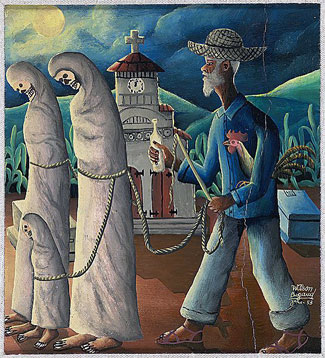
Zonbi
A good priest will have good character. Noone is perfect but they should have a sense of nobility in being trustworthy and be able to control themself and not have knee jerk emotional outbursts,

Vodou altar

You should not set up a table without guidance for the reason stated above. To work with the Lwa that you actually have, under an initiated priest. Be open to the spirits you are guided with and not just because you want this or that Lwa. Just because Erzulie is known for love, does not mean that many other Lwa cannot also perform this work, or want to perform this work for you. Once you have an idea of some, with guidance you can set up a prayer table. This is not the same as the priests altar who have received the spirits in ritual, or have been passed down in an unbroken family lineage.

Certain spirits go specific places, some do not like each other, certain things must always be present. 

Buying a statue is empty plaster, there is no spirit there. A priest does not need a veve or statue to have contact.
People need to start thinking spiritually and not materially.
When you become an initiate it is like an attunement internally, a foundation: pwen or a spirit point. Which joins the body and head to the spirit.
If you buy a statue or a doll it must be blessed or baptised by yourself at least. And it can be a gift or an object of meditation but do not mistake it for the Orisha nor Lwa, nor spirit guide. Do not buy all the Orisha or Lwa oils baths and candles from the botanica, they make a nice gift to the spirit but they are not traditional. Using these things all together is not Vodou. The religion or spiritual tradition of Vodou has its own traditional recipes for making baths and lamps that are passed down and not full of synthetic ingredients. If they are used they are usually added to other things, such as a fixed candle or lamps with other fresh herbs or natural oils. We do use many spiritual waters and perfumes.

Of course dolls and statues or pictures can be prepared as pwen. No pwen: no license or attunement with the spirit.
Spirits cannot be bought. Bought Pwen "Achete" are usually but not always contracts facilitated by the priest. They are the dead, earthbound and intranquil, djabs/demons/devils or Petro spirits usually for hire. They are not usually hereditary.

They must be paid, fed and worked with a certain way or your life can become a disaster.
The rada Lwa need to be fed, and given exchange, but again you either have them, they are interested or not.

Others say no altars in a house that is not really yours or is not a family house. Some altars are set up not to be moved and they are there for life. This is because in a traditional African shrine, the land and land spirits are familial, ancestral. Where you are born and buried are linked to family lineage in the root branches connected to your family lines of spirits.

With a prayer table you've created a sacred space designed to focus your faith and attention on your practice. It is intimate, singular and particular to you and it represents your understanding of your relationship between yourself, and your Lwa trhough the lineage you have approached. It is invested with a tremendous amount of your personal spiritual power, energy or ashe. Offerings and prayers can be given, but they are only vested in you, and not do work besides protection and perhaps occasional small petitions. Big work requires more engagement. and not a simple offering. Do not promise them anything you are not able to fulfill. They can be bargained with possibly.

An altar, on the other hand, has been specially prepared and inhabited by the Loases it was made for. It is also indicative of your relationships with your spirits but is reciprocal. The Vodous are actually in the altar and do more than just receive offerings, honor or veneration. It is working with them instead of only serve. Many confuse the word honor or serve with working or petition. The priest only has or can install this altar to a spirit in person.

Sancista 7 Crossroads


Tuesday, September 27, 2016

September 29th Date of the Archangels, Oct 2 for Guardian Angels known or unknown head spirit

This is an important feast date for healing and protection, as well as honoring these Lwa.
Beli Belcan is the Lwa who uses the saint image of St Michael. September 29 is Michaelmas. He chains up bad spirits and is a warrior.
He has a sword and has the power of fiery lightening and of God.

Tindjo Alawe is the head of the Indio division of Lwa, and has domain of cleansing, healing and the water of rivers. We use the image of St Raphael who has a sometimes has a gourd staff and rod with fishes. He wears robes of green of the indian spirits, sometimes blue of the river, and pink as the colors other lineages use together.


If you do not know if you have these Lwa or have not received them, you can still work with the angels, in particular St Michael as revocations can be done to remove negativity and bad spirits from us, and for justice.

Resguardos, like mojo bags can be prepared under him for protection, and prayers can be given with a novena saint candle, or a red candle. Do your prayers to God and St Michael over the bag each day.
The recipe from my godfather for St Michael resguardo:
enough red candles for 9 days or enought novenas, set one red candle 
beside a clear water glass and st michael image or prayer card if not using novena
small red bag, tie with green or red string or ribbon when assembled
cleanse items with rum, florida water and tobacco smoke
cross charm or sword of cross
4 clove garlic
st michael medallion
seed of quita maledicion or stop evil
piece of paper with persons name

optional from others variations:
anoint with st michael or protection oil
thunderstone (pied de rayo) and stones of protection
3 peony seed against evil eye
dried bay laurel leaf, angelica root or vencedor leaf (lilac) for success and higher spirits.

Also from the book Hoodoo Herb and Root Magic comes this old-time conjuration of Saint Michael Archangel for protection from evil:

Home Protection Packets
sew small cloth packets filled with grains of paradise seeds and 
glue or crochet a holy card of Michael the Archangel to 
them. Sold in pairs, one to be placed at the 
front door and one at the back door, for the protection of the home.


San Miguel Vencio! San Miguel Vencio! San Miguel Vencio su enemigo con el poder de Dios!
(St Michael vanquishes with the power of God)


For the uninitiated you will not know your met tet until it is confirmed in your baptism and crowning or possibly at kanzo. You may have an idea who this is but it cannot be confirmed until then.
However you can begin to strengthen this connection by using the image of the 4 archangels, but many also will use the image of the guardian angel to represent them as is in our lineage. September 29 is the day of all the archangels. The words guardian angel describes our met tet, the Lwa who rules our head, and is not a spirit guide. This is not the holy guardian angel or hga, the higher self.

You can either find a candle with this image, or print it off in color and tape it to a white novena, glass chimney candle you can find at the dollar store. Blow cigar smoke over it or frankincense and myrrh, and anoint it with olive oil, or some kind of protection oil bottom up.
You can also get a guardian angel saint card, and use white candles.
It is said that everyone has a tutelary met tet, a Lwa or Orisha at birth. I do not know if this is true, however one can step forwards for you and claim you. Following the directions below to perform a novena with or without the headwashing can help you on your spiritual journey into these traditions, along with starting ancestral veneration as the foundation.

It is fortuitous that September 29 2016 is on a Thursday, the day of the Rada Lwa, however Saturdays are also used for most Lwa. In the Catholic dates they use October 2.
If you missed September 29th to start, this can be done whenever you wish, and the headwash is usually done once a month to every two months, called a rogacion. The rogacion you will perform is not the same as receiving it from a priest or priestess of Lucumi, whose energy or ashe is in direct attunement. The recipe is similar to what I posted on ancestral connection bath.

Do your prayers everyday until the candle has burn out, but if you can use several candles for 7 days. As 7 is the celestial number and of the number of chiefs and families of Lwa in Sanse. There are also 7 archangels, 1 for each day.
Although a novena is traditionally done for 9 days.
Speak from the heart, of prayers of protection, and what you need guidance with. Feel free to substitute the word God with the name of God of your understanding such as in Vodou as Papa Bonnye (Bon-yay), Bondye (Bon-dye), Or Papa Bon Dios, as we are a monotheist spirituality. Or use Odudumare (Oh-du-du, mar-eh) if you feel your path is more of the Orisha faiths such as Ifa or Lucumi. Or you can use the phrase Great Spirit.


Here are some sample prayers for you to use, which you can find from several Catholic sites online:
You may also want to use psalm 91. 

         1
Angel of God,
my guardian dear,To whom God's lovecommits me here,Ever this day,be at my side,To light and guard,Rule and guide.

Amen.

     2
Guardian Angel from heaven so bright, Watching beside me to lead me aright, Fold thy wings round me, and guard me with love, Softly sing songs to me of heaven above.
    
       3
O angel of God,
appointed by divine mercy to be my guardian,
enlighten and protect,
direct and govern me this day.
Amen

                 4
 GOOD NIGHT, my Guardian Angel, 
The day has sped away; 
Well spent or ill, its story 
Is written down for aye. 
And now, of God's kind Providence, 
Thou image pure and bright, 
Watch o'er me while I'm sleeping----- 
My Angel dear, good night!

             5

Novena Prayer

O most faithful companion,
appointed by God to be my guardian,
and who never leaves my side,
how shall I thank you for your faithfulness and love
and for the benefits which you have obtained for me!

You watch over me when I sleep;
you comfort me when I am sad;
you avert the dangers that threaten me
and warn me of those to come;
you withdraw me from sin
and inspire me to good;
you exhort me to penance when I fall
and reconcile me to God.

I beg you not to leave me.
Comfort me in adversity,
restrain me in prosperity,
defend me in danger,
and assist me in temptations,
lest at any time I fall beneath them.

Offer up in the sight of the Divine Majesty
my prayers and petitions,
and all my works of piety,
and help me to persevere in grace
until I come to everlasting life.

Amen. 

         Novena to Guardian Angel

O holy angels, whom God,
by the effect of His goodness and His tender regard for my welfare,
has charged with the care of my conduct,
and who assists me in all my wants
and comforts me in all my afflictions,
who supports me when I am discouraged
and continually obtains for me new favors,
I return thee profound thanks,
and I earnestly beseech thee,
O most amiable protector,
to continue thy charitable care and defense of me
against the malignant attacks of all my enemies.
Keep me away from all occasions of sin.
Obtain for me the grace of listening attentively
to thy holy inspirations
and of faithfully putting them into practice.
In particular, I implore thee to obtain for me
the favor which I ask for by this novena.

[Here mention your need(s).]

Protect me in all the temptations and trials of this life,
but more especially at the hour of my death,
and do not leave me until thou hast conducted me
into the presence of my Creator
in the mansions of everlasting happiness.

Amen.

The head wash recipe is as follows. 
Break open a coconut and use the water into a white basin, you cannot use coconut milk or water from a carton. You can mark the coconut white all over with cascarilla first on the outside if you desire. You can also take a second coconut marked in this way and roll it around on top of your head and behind your neck. This one should be kicked down the street or put in a grocery bag and disposed away from the home, off the property line.

You will also need into the white basin:

cool tap water or fresh river water
Add cascarilla chalk or crushed white eggshells
small amount shaved cocoa butter
These items are traditionally put on a white plate and placed on the head first along with the whole coconut.

Mix and mash these items with your hands, putting your energy and intentions into it as you repeat your prayers and call with your thoughts, as well as speak from the heart aloud to your guardian angel. Pray over this mixture the first night of the novena and perform this.
Take the mixture into the bathroom into the shower area, and bend forwards, pouring the mixture over your head. Do not rinse. This can also be done with a clear or white cup over the basin in front of your altar.

After you will need to wrap your head in white, wear white clean clothing and sleep like this. 

With the remains of the mixture, you can place your novena candle into the center of the bowl before your altar, or at your bedside if you have not constructed one yet. After your head is wrapped you can also mark your body with cascarilla for extra protection in x's or +'s on the back of the neck, belly, top of feet and on wrists. This can all be rinsed off with a regular shower in the morning.

For 24 hours no sex, drugs, alcohol, swearing or bad behavior to get you in proper alignment and for clarity to strengthen the mind. It will help your faculties, and focus on goals, destiny, spiritual progress and path, as well as guidance, cooling, for peace, and calming the head. It is cleansing, away from bad influences, thoughts, illness and misfortune. It feeds your internal knowing, called Ori by the Yorubans.


Be Blessed,
Sancista 7


Saturday, March 19, 2016

Hoodoo, folk magick and Voodoo differences

Hoodoo is a system of largely protestant based rootwork or plant work, combined with biblical passages such as the psalms. Some do work with the dead in terms of animal bones, and different dirts including grave dirt. There is believed to be spirits within the plants, and are the main spirits worked with outside of Christianity. There are allegorical teaching stories used such as briar rabbit and trickster spirits from the native american, african mix saw the similarities with their spider Anansi. Being protestant, there were no saints to preserve african spirits as well of the Orisha, Mpungo or Lwa, and the slave masters were less understanding of idolatry.

To facilitate this practice graveyard work including mediumship with the dead is employed, but it cannot be readily identified as necromancy. In modern times (the last 45 years) many who practice folk magic have joined the afro spiritualist or spiritualist churches which some are more Catholic based. Not all hoodoo or root workers are in the spiritualist church. This lead to the inclusion of spirit guides such as Blackhawk, 7 african powers and la madama from endless commissions of spirits incorrectly without reference, as practices and knowledge around these spirits were not passed on from the cubans and puertoricans from which they originated, known as espiritismo or the spiritualist church outside of the more european kardecian based.

 Many people want to use the items in a botanica, but they have no power sitting on a shelf. The 7 african powers are not Orisha, they are various dead warriors from different african tribes from puertorican espiritismo and not the Cuban religions. This was further confused with the image of the crucified jesus as the just judge, Ogun or Olofi. Many different images of the Jesus and Mary are used for various african spirits where there was Catholicism. The Cubans do not use saint images for their religious item for the spirits, it is just decoration. They receive the spirits in a pot in ritual. From what I have read about New Orleans, the catholic italians and irish kept to themself, although the pomp certainly was appreciated by the rest of the population, and welcome during open house feast dates of the saints.

There is some speculation at this time how someone from an American east coast european spiritualist church could found a southern afro church without having any public information about lineage, because they did not have our spiritual pots and teachings. It is possible that a congo based practictioner helped create this as Chicago is not far from New York where there is espiritismo. In which case Blackhawk no longer was a spirit guide and became more like a spirit of the dead in an nganga or nkisi which can be birthed from to another who already has it. Unless this pot was created because his spirit guide statue was unable to be prepared in the afro spiritualist way. We also have indian pots, if a person has several indian spirits or ancestry as do those in Dominican Voudou called a Tindjo as a portal, and this could have been appropriated or influenced this creation.

I have contacted a hoodoo author about this question politely with no response, who supposedly held the lineage of Blackhawk into introducing it into Hoodoo. Quickly glancing at one of her books online, she had a section on how to work with the spirit of la madama, which shows the lack of cultural connection, as she is thousands of different individual people who is a spirit guide to an individual, of which not everyone has one in this category, nor have the same indian guide. Hoodoo workers going out and buying a la madama statue is rediculous.

 In more European spiritualist churches good spirits have to acknowledge Jesus. These spirit guides are concerned with one person only. People may be attracted to the image of a specific historical indian perhaps because they have a spirit guide, no two will be alike however, and cannot be willingly passed to another person, or in life. Many people like the image of La Madama, but she is hundreds or tens of thousands of different dead people in that class, all with different real names. A person may have a Congo or an Africana, as black dolls are not all the same person, class or culture. Spirit guides come from seances, in which advanced mediums in community identify your spirit court or entourage, and no two people will have the same dead muerto or spirits. This is not something a person can do themself outside the traditions of spiritualism. People even have confused the Lwa statue of the african man Candelo as a folk saint, or these spirit guides as folk saints.

Hoodoo is folk magic that does not use african spirits, or pagan spirits, however in modern times the usage of Catholic saints has been added, again by going to botanicas and imitating african religions such as Santeria. Santeria is really magic with the saints, but came to also incorrectly be the term for the Orisha religions of Ocha, Lucumi and Ifa.

What most people think is New Orleans Voudou is in most cases actually folk magick, heavily congo based, incorrectly attributed by white ethnographers whose missionaries treked heavily into west africa and identified anything remotely african as Voodoo. Modern pracitioners in the area are mostly Haitian initiates, and the records do not identify Lwa as being ever mentioned or prevalent in this area. The slaves in the area were mostly Senegalese and Congo, and can be reflected in the usage of red and black for some Rada, the inclusion of european poppets with "nails" not understanding the congo nkisi, and they were not used of curses. Nails are used for differing reasons, but share the marking of intention. THERE IS NO SUCH THING AS A VOUDOU CURSE. It is outside the religion to do so.


Really voudou dolls do not exist. These things are not seen in any other branch of Vodou for the most part or have very different uses and meanings. Dolls are used throughout the Caribbean to represent an ancestor, a guide or spirit they love. In other african diasporic religions such as palo they may make a doll for a client to work in absentee, such as protection to keep in a temple, much like a pot de tete in voudou, items are made with personal hair clipping or nails etc is included as just one of the ingredients required.

 Also the emphasis on the color white is in voudou for rada Lwa, with red and black used only for petro. Black is rarely used otherwise, except for a few Ghede or Ayizan along with other colors or white throughout Voudou diaspora in the Caribbean. In Sanse we use purple and white for our chief Ghede Limbo, and black and white for the Ghede family. I do not think people understand the use of color, why they are used, its not just, those are their colors. Red and purple are considered hot, black and white are cool, with black being lower and darker. Black and purple is more so with riling up the dead to send them out, hot and dark, such as with bokor tradition outside of Voudou. Some Haitian hounfort are two handed. We try to make the influence of the dead more kindly yet active with the "choice" lineage of color. There is no preservation of Ifa with the Orisha either, or the inclusion of Ellegua. The Orisha mostly exist in a form of Ogun, and not many female Orisha survived in Vodou. If they do they are 1-3 from a family passed down. Red and black is also more congo with their crossroads Lucero spirit, or within congo based Quimbanda with their Exu and Pomba gira crossroad spirits. Unfortuenately people mess with what they do not understand and is beyond their egoic control, or knowledge level.

Unscrupulous uninitiated authors have tried to make an afro wicca out of new orleans "Voodoo", as there should be no pagan Greek or European spirits, they should not use spirit guides like espiritismo, and they should not have a whole pantheon of Orisha to choose from or Ellegua, and does not include western magick of hermetisicm. Most of any remaining west african practices have likely gone underground due to the tourists, or are practiced by Haitian lineage. Meaning they are Haitian immigrants who recently brought their religion, or Americans who went to Haiti as is required, not new orleans Voodoo. Any native new orleans Voodoo within the confines of one city that possibly existed largely left or went underground within Louisiana.

There was seldom any Caribbean to America transport of slaves by prohibition law. And there is no other indigenous Voudou or African religion diaspora origins in America. It has become a tourist collection of museums, gift shops, tours, and books to make $$$$$$$$$$$$$$$$. Just because there are cultural mixes in tradition doesn't mean people can just grab anything, and say "well they did it, they mixed things". Who's "they": the slaves who were forced to, and hundred to thousands of year old traditions these tens to hundreds of thousands of people agreed upon. They died over t preserve their tradition the best they could and made informed choices to changes or substitutions based on cosmology or philosophy.

Madam Marie Laveau was a Catholic, relatively middle to upperclass free buisnesswoman, of mixed ancestry, possibly part Haitian, said to be American born in some accounts. Written suppositions are often more fiction than fact at an apprasial of the wikipedia page. She possibly married a 3/4 white Haitian man who shortly left, and then she studied under a Senegalese man Dr John, a hoodoo worker. Her chewing peppers for justice in one story, crying with red eyes reflects the congo as in petro. And then there is congo square, where she was seen dancing with her snake possibly named Zombi, performance art or no, Nsambi was the congo god. Yes we have the snake dhamballah, but the congo makaya tribe is where we get the Simbi Lwa. The mojo or gris gris bags came from a Senegalese or wolof word. The original bag was red flannel, and only used or had access to white or yellowish tallow candles for the most part.

There is a system in which any venerated dead of any religion or people can become Lwa however, but would be within a religious framework of Voudou. There is also a seperate ancestral veneration by their own family or cultural group or tribe. Did Marie Laveau practice voudou?, its very doubtful. But if the stories of her nursing epidemic victims is true, she definately deserves veneration, and as a folk magick practitioner and diviner.

 The disgraced author Tallant is generally regarded as grandiose fiction, who again called all african folk magick and cursing voodoo, even Zora Neale Hurston was doubtful about the existance of a public or widespread voudou lineage as an ethnographer. She stated on her visit (sic), "the african rites, with names that rivaled those in Haiti", but they were not similar, nor recorded. My guess is they used the congo name for god, Nsambi. In our spiritual house, we hold secrets, all I can say is that Marie Laveau is venerated, and a congo spiritual worker through Palo Mayombe. JFK was made into a voudou Lwa by some Haitians. A bishop? who harried the folk practitioners in New Orleans was supposedly made into a Lwa, who hated any spiritual expression other than than Christianity. Both were not practitioners of voudou in their life as far as is known. Can a spirit guide become a Lwa? Yes by a legitimate voudou practitioner with legitimate reason such as connection, as we do not work with a whole pantheon. Scholars are now beginning to write about the difference in african tribes and their influences in the new world, previously inaccurate reports from largely white missionaries is what shapes most and outsiders viewpoints on this subject to this day.

Obeah from Jamaica has practitioners also in a tradition of spiritualism, pocomania or revivialism. Obeah is heavily folk magick based, and ceremonial magic based using the 4th and 5th books of Moses. Folk magick, ceremonial magic and sorcery is evident within the Bokor, secret societies, black lodges of Haiti, and is not considered religion nor Voudou, even if used for healing. They do use Lwa more so the congo based Petro, Baron Samedi and Kalfu (carrefour, four square).

Some people identify Hoodoo, conjure and appalachian magic as the same, but they have regional differences. As explained to me by my apprentice, Appalachia has more scottish roots, Granny or Hexen has more dutch germanic roots with hex signs etc that mixed with natives to use pow wow healing methods, and hoodoo is more african based. Conjure can be xonidered more spirit based. Although each region included european, native american and african practices, they settled into slightly different traditions and had different local plants.

These were family traditions, mostly practiced in solitary, or passed down one on one orally. Thus it is very difficult to learn accurate practices from books or the internet.

The spiritualist churches as in the african based espiritismo has baptisms, and some hoodoo practitioners say they have baptisms outside the catholic church. Hoodoo is not a religion however, and many have no such practice. This lave tet is also done in Vodou which is an initiatory religion and uses the Lwa, of which only a few concern the practitioner and not a whole pantheon. The Orisha people only possibly had one or two out of hundreds in Voudou passed down by family lineage and not generally within the religion. In New Orleans some Voudou houses say they have no clergy nor initiations which mark religion.

 Many people want to work with african spirits uninitiated, but this does not exist outside of lineage, whether family or orthodox. These african diasporic religions do not contain a bunch of spells, as the magic is inseperable from the religion's services, practices, spiritual point of access passed to you in intiation or blood lineage and rites. Voudou is life, largely in the moment and experiential in congress with spirits. The spirits come in physical mediumship and interact with the community, that is Vodou.

Many seek to keep the people of the culture and these spirits at an arms length with over intellectual approach, such as through a books, but this is impossible as a way to practice. You can study the culture, but not the religious experience this way. A Haitian American said, "voudou pas des livres". I agree voudou is 98% without books, leaving room for creativity and cultural study once you know the spirits you are supposed to be working with through your initatory rites and services.

People from Louisiana, shameless profiteer authors or newagers can get as mad as they like about what I have said. The unitiated authors neglect to address these issues I have raised, nor have the lineages to back it up, nor allow disagreeing viewpoints on their pages. In Africa there were royal priest kings, and there is no guarentee of this connection now, outside of unbroken family lines and religion. There is nothing wrong with hoodoo, it is awesome folk magic, but its not Vodou religion either.

Wednesday, March 9, 2016

Mi Sanse: Our rama and keeping the traditions pure in the diaspora

Some people talk bad about Sanse's seeming eclecticism of borrowing from several traditions. These people are overall not really familiar with the tradition, and see or hear of our tools, rituals, statues, or pots and often mistake things for what they are in other african traditions because they look similar. While it is true some people of every tradition add or do things they are not supposed to in their tradition, it really is a disservice to blame the tradition itself which has some similar origin.

While it is true there are regional or house variances, some things do remain the same (for the most part calling the spirits with small variation, initiations and ways to make objects) which define the cultural branch, so it is not true to say there is no one commonality of tradition within a Voudou branch either. People will always say other people are not doing things right but these and certain things should remain relatively the same. Within a branch depending on lineage in Sanse or other branches of Voudou, they may have a different group of spirits served, depending on a) branch or b) temple, c) personal frame or entourage of spirits called a spiritual cuadro, court or frame, which is not chosen by the individual and revealed in ritual.

We should respect the traditions of the new world as being seperate localized mixes in Voudou, and their beautiful differences  in the diaspora which are no longer entirely the same as it was in Africa. In some such as in Palo Mayombe moreso especially, and various Palo branches are purely Congo. Whereas the Lucumi religions of Ocha who serve the Orisha, incorrectly termed Santeria (folk magic with saints) retained its Yoruban roots with varying degrees of Catholicsm. Some have gone back to Nigeria and practice Ifa, the root Orisha religion. In the diaspora, the saints are viewed as being on par with the misterios (Orisha or Lwa), or the misterios are viewed as saints, thus confusion, We are monotheist despite claims of how it might have been once in Africa at one time past.

Sanse is a puertorican branch of Voudou, roughly 100 years old, it is predominately west african and catholic in pantheon but has strong congo roots. Our music is all palos, congo drum beats. Voudou such as in Haiti honors the different african tribes, with families of Lwa, and nations, called in order with different dances and drumbeats. It is our belief that an exhiled dominican man who was a Papa Boko of 21 divisions, also called Dominican Voudou by nonlocals, came to Puerto Rico and pacted with Baron Samedi, a Ghede Lwa to form the tradition of Sanse when he saw the local spiritism with the dead. New Voudou lineages and changes in reglemen or rules cannot become created alone from a man or woman declaring it to be so. This is how some of the reglemen in Haiti with the asson lineage was solidified after the first revolution, with a Houngan and the Lwa Loko.

There is not largely a haitian inheritance into Sanse, although many in the north and border of Haiti still practice the tcha tcha lineage way of 21 divisions. We see their Lwa as cousins if not shared, but they can come through. And in the case of our house, many family members and great godparents and uncles were haitian. We stick mainly to the cool tolerant Ginen root Lwa of the Rada, although Petro can be present for a person and honored. They are otherwise not generally called or worked with in our branch of Sanse. We do have 21 divisions in our house and that would be more the route if to be a regular practice. Many haitian houses also do this, only serve Ginen.

Some houses in Voudou avoid the Ghede too, but Sanse deals more with the nonancestral dead like Palo, than some other branches of Voudou or Ocha, where there is some taboo or just not the focus. The ghede are important in Sanse because of voudou, and our focus with the dead. I was taught how to call and do some Petro Lwa management, but would not do this except in crises, nor readily teach this until a student could show responsibility and had learned everything else first in Sanse. I respect them no less than the other misterios, but know how hot even Candelo can be in his manifestations when irked in physical mediumship, or some ensclavos slaves or even dead in a misa or fete, that it is more than most people not raised in the culture can understand or deal with outside of speculation, nevermind purposefully invite.

 The dead when they operate this way are easier for an espiritista to deal with than the force of Petro Lwa, even by priests, who cannot really be controlled only guided or calmed. The Petro are revolutionary and warlike, outside social mandates, can be psychotic or demonic,  not evil, but can be unforgiving, be demanding, deal out punishments, act aggressively or be violent. To put a candle and do a spell infront of a statue or image and say it is an anima sola (tormented "purgatorial" or earthound dead) or Petro spirit is different than them actually being present or served, using necromancy or know how to deal with them safely. There is alot of wishing, hopeful thinking, foolish egotistical ineffective or unsafe practices, and over intellectual self gratification versus actual (oh shit) moment of actual work and of unimaginable feats, presence and fallout.

There was a greater movement between the caribbean islands than there was caribbean to America until recently. But this does not mean Sanse practices the same as the haitians or cubans. Nor do we practice the same as the dominicans, although we view them as our parent, and we are closer, markedly in my house. Cuban espiritismo is very close to the espiritismo in Sanse, but not exactly the same. They keep their ancestors and guides seperate on the boveda and on a spiritual table or tableau espiritual. I am not as familiar, but they seem more christianized.

European academics called everything african in the new world voodoo, adding to the confusion to the layperson. Sanse practices spiritism mixed with local ancestral practices, more correctly folk spiritism espiritismo, heavily influenced by Allan Kardec and Catholicism. However the seances, also called reunions, sessions or misas are kept seperate from the higher spirits called misterios such as the Lwa in Voudou services. The table of our dead of guides and ancestors is kept seperate than the divisional table with the Lwa. Most saints are kept off the boveda in my Sanse unless for a specific reason such as for light or as a cover for the main spirit guide. The saints are kept with some of the Lwa. It can be seen as two traditions in one, yet kept distinct.

It is rare but there are a few exceptions to this rule of seperation, as in cuban espiritsimo higher misterios but heavily related to the dead such as the form of St Lazarus or as Babaluaye, I have heard, has come to misa in physical mediumship or mounted a person, likely when there was Santerismo ( practioners of both espiritismo and Ocha present). I have not seen this but Candelo has come to a crowning in epiritismo with misa when there were sancistas, santeros and palero/as present. He is very important in our temple and although viewed now as elevated Rada, he has Petro aspects by being a new world or american spirit, and viewed as coming up through being a Ghede slave.

Picture of Lwa Manifestation of General Candelo Cedife in waterglass smoking 3 candles
This is my original work .

Otherwise the Lwa do not come to seances. We can have any dead come, hopefully the good only if the session was set right, although part of our work is to help and process other spirits. This means dead houngans, mambos, mama mambos or papa bokos, santeros, paleros, africans of several tribes etc as priests can come. Most times they retain their religions, and will take on aspects of a higher misterio as they become like in energy stream. They may act like or give the name of a Lwa, which many outsiders or unpracticed will take for the Lwa themself, but they are really an emissary an emissario dead of this other spirit. For example they may say I am Ogun, or Charles Ogun or Ogun Charles or give some other combination of names. There are many ways of determining who the spirit is when they come and names are only a small part of our assessment as priest/esses. This is why some people mistakenly get upset that they think people are claiming Lwa are coming or being faked in seance, when it is still the dead.

Although any Orisha acknowledged are under Ogun in Voudou as the Nago nation, we do not view Ogun as the most part as being the same as the Orisha Ogun, and the Lwa are legion or many under a chief/tess, whereas the Orisha are seen as one Ogun but having different roads or paths like flavors to their aspects. For example there are almost limitless Legbas in the Legba or Lebane family, but most people have only heard of Papa Legba. Wheras to my understanding, as I cannot legitimately speak on the religion of Ocha or Ifa, there is only one Yemaya, Babluaye, or Ochosi but with different "appearances"or ways to come through.

Candle manifestation of my Legba during a simple offering. I never touched the wick to make the cross and staff arrangements.
I was using St Christopher at the time, still do along with St Anthony


Because slavery had a mix of african tribes in the caribbean plantations, some lineages retained a handful of familial or hereditary Orisha along with their Lwa in Hispanola or Puertorico. As there are hundreds of Orisha, not many made its way into the predominately west african influenced sect. There is not a whole pantheon to select from, neither is that the way Lwa or Orisha are worked with. In Hispanola they may still use just the ovoid smooth river rocks to represent their spirits, or throw the cowrie shells Ifa, which is not generally found within Voudou orthodoxy:temple religion. They can use special stones to represent Lwa. There are these family lineages who may retain only about 2-3 spirits they pass down to their children, who may never kanzo or initiate into the religion, but be associated possibly with temples, especially for larger issues. In Sanse we do not throw shells of the dillogun, Ifa. Nor the coconut or kola nut shells ncobo to the orisha, nor the chain, or chamalongo to the mpungo palo spirits.

In my lineage of Sanse which was recieved from a puertorican family tradition, we do not work with the Orisha at all. Our spirits are the 7 chief Lwa of our lineage, along with  handful of other lwa who may be personally interested in the individual. My godbrother who is also puertorican, came from another house in Sanse before joining ours, and does honor a few orisha in his spiritual court. I believe this is because of his bloodline, but also a few Orisha may call to a person regardless of race. The difference is in working with the spirits who are truely in our spiritual court, besides our 7 Lwa pantheon. I have no Orisha as a Sancista, however the congo do call me. 4 people therefore, within 2 temples and 2 puertorican family groups, have one or two each of Orisha that I know of. So that is about 5 percent or less that are known in my experience of people who have Orisha coming through Sanse or associated espiritistas. I am not saying this is generally true. When this happens that an Orisha stands for a person in Sanse we can give general offerings, petitions and fetes to the personally involved Orisha.

However we do not crown or give the Orisha.We do not make items under the Orisha such as macoutes (like a paket), elekes (necklaces recieved in ritual from the orisha religion rituals) or Orisha pots or in soup tureens as in Ocha. I recommend to be referred to a Santero in our community for further guidance with these spirits to serve them, for directives and any large issues if they are very present. If someone goes to a Santero outside of Sanse, with no prior contact with Orisha, now with direction honor their Orisha, they do not now include them in Sanse, they are kept seperate as Ocha. We can petition, but should consult with a priest to mediate the offering desired if serious to make them happy because the shells and authority speak for the Orisha, not just by psychic thought, and they do not always want the same thing all the time and for different work.

They are otherwise treated as a saint, but we know our spiritism can be 20% wrong if we are excellent, and to have humility and respect. One must receive Orisha in Lucumi religion properly to do work for others with Orisha, and empty statues are not the point worked with. Just because we have an africana spirit guide, does not mean we can give them things to make under an Orisha for another person. Our spirit guide would work for us only on these matters on their discretion with or without our request or without our direct involvement. We are Voudouisants and Espiritistas and not Olorishas.  Repeat: We are not Orisha priests. Even when people receive the Orishas in Ocha, there are levels that they can only work with them for themself, and not other people as priestclass. There are many many taboos in the regla of Ocha to be observed: rules. It does not matter that spiritualism has made is way into indigenous cultures all over the world, that we can now claim to properly work with their spirits either.

I will say that folk saints are the exception. We should honor and be sensitive to their cultural origin, but again, they are the dead. They will have more personal preferance who they want to work with or if they are in your court/ than cannonized recognized official saints who can also show interest or preferance. They mostly like to be kept by themself, and honored in specific locations. Official saints can be approached by anyone, but again they might just be a beneficial or random dead stepping into that mask, which is problematic for the unitiated working with african spirits through or with the saints or any images......without the spirit point, crowning or direct guidance. Official saints are venerated elevated dead, and the Lwa, not all of them have had human lives, nor the Orisha.

If a person has a frame with more Orisha, they should consider Ocha or Ifa instead or as well after Sanse. (perhaps due to the order sometimes desired by crowning Orisha). If they have alot of congo dead, they should maybe look into Palo. That doesn't mean they should not do Sanse however, which can only add ability or psychic sensitivity. Some like the purity, groundedness and coolness that Sanse can balance a more firey or lofty tradition, although these other religions are on their own and independent entirely. If a person has a lot of problems with the dead, or their dead require a misa, a santero may then refer them to an espiritista however, if they themself do not practice this, have them host a misa for the dead in their community. Some in Ocha, as stated, are also espiritistas, and so are some palero/as also espiritistas. Some in Ocha or Ifa are also in Palo, but we keep our religions and traditions clear and seperate when practiced. But when outsiders see a priest with various items or practices, even if seperate, might think them all the same culture or tradition. We have many traditions and african religions in our house and we respect each other.

As sancistas, we do not work with the Mpungo spirits, incorrectly called the fetish name Nkisi's of Palo. We do not use the symbols or sigils, the firmas, patipembas, or ponto riscados of Palo, or the Exu and Pomba Gira spirits of brazilian Candomble, nor any other diasporic cult. We do not wear the cross body bead sash, the bandera of Palo. Our spiritual cauldren, cardero or caldero resembles an nganga, kindembo or prenda, but is not built the same, neither is it under the guardian as in Palo. It is also a portal to the dead, especially congo for us. And in Sanse there is normally no animal sacrifice, which is needed to feed alot of these items, rituals and offerings made in the other branches of Voudou, and other religions of Palo and Ocha. So we should not claim or pretend we are the same, and it does not make us as sancistas, any less. Normally the Petro or sometimes Ghede rituals do require blood, and this can be outsourced within our community unless a Sancista is crosstrained.

 We have a clay pot called a tindjo that some lineages of Dominican Voudou have, as a portal for the indian spirits, especially the Taino and Arawak speaking first peoples who lived in many areas such as Puerto Rico and Hispanola, especially if this is represented in our guides or ethnicity. We do not make pots for every single Lwa or for Orishas, but we do have a head pot with our guardian Lwa which also links us to our frame. We do have some small pots beside guide dolls if they cannot be hollowed out to be prepared to contain their secrets.

When you see "new age" items, or other modern religions and ideas such as Wicca, added or other cultural influences it is a personal preference, heritage, or an addition, or under the personal preferance of a spirit guide such as astrology with an asian or arabian spirit guide. Our guides retain their folk practices or religions, such as you may see a Ganesh elephant god statue beside a Hindu spirit, on or beside the mesa blanca white table. That doesn't mean that kundalini, chakras, or now Hinduism, other paganism, their gods or polytheism is now Sanse. But that doesn't mean you shouldn't explore the teachings of these areas if your guide tells you. There is no one true religion revealed on the otherside once we die. It is my belief that we go and who we associate with as spirits is where we have spiritually aligned. This can change after lifetimes or incarnations. We rectify the idea of other gods as not needed in our framework, as demigods or on the mystery level, and that there is still one unifying manifesting source. That does not mean it is ok to keep greco-roman or european gods with the Lwa, although Thor is used by some for the Lwa Papa Sobo and Bade twins because of the goats and association with lightening. I mean, Barbies can be used, hair dressing heads, movie posters, or baby dolls too for some Lwa. The point is keep the traditions seperate, despite the imagery seen.

Many like the idea of ceremonial magic, but truely most people have a poor understanding of the grimoires. The inclusion of catholicism/christanity is heavily veiled mysticim and qaballah magic itself. We can practice all kinds of folk magic, hoodoo, or congo spells, even under our misterios or muertos/dead but this is not Voudou nor Sanse propers core. We do not do hurtful magic and call it Voudou. We can add what we like and have flexibility and in the way we do and interpret as we are not overly dogmatic as long as it is not claimed by anothers religion in which we have no right or authority which would be disrespectful. Be clear about what is original to be preserved. We need to be clear what is Sanse. And hopefully I have been clear what Sanse is, and what my Sanse looks like.

My godfather says, "you can add, but never take away, and be clear what you have added". Sanse is not therefore, anything and everything added including the whole fridge and kitchen sink.
That's why I teach 100% traditional, as I was taught, and then explain how I like to practice if any differences they might see, and the reasons why the change is acceptable. For example, heartfelt prayer in the right energy polarity and elements needed, yet nonchristian, can be used, although I do both in espiritismo. It is up to the child how to proceed traditional or their educated variant, yet able to pass on the tradition intact. This also helps one learning to understand the why of how we do things and what the words mean in code, instead of parroting memorized scripts, adds feeling and success to the desired effect.

It is true spiritualism or working with the dead is not a religion, but in my opinion Voudou is even if some say Sanse is a spiritual path and not religion, and is compatible with any religion that believes in a higher power, it still contains Voudou, is not a solitary practice, within a society. It is true that these religions are more a way of life than some, in comparison to leaving it at the church on Sunday, as a living tradition because it is so experiential. Some do practice espiritismo unbaptised (uninitiated), or by association, but the protection it can afford, and the inner teachings are imperative with a lot of involvement or when "unwanted" possession or getting ridden by spirits occurred that mediumship is happening. Inversely if no or limited experiences are happening it can help evolve your abilities and forge these spiritual relationships and connections.

Let's respect the traditions and keep them intact and alive, even if they evolve. The problem comes when confusing other people, when there is no training in these other traditions. People think Candelo, Orisha or espiritismo such as Mama Francisca is Palo Mayombe. Some Orisha did go into other branches of Palo and Christianity. People thinking spirit guides or Candelo are folk saints, or that La madama is one person anyone can work in hoodoo. People tagging Chango statues as Candelo, the list goes on.

This is understandably why some people get protective of their traditions, when it seems people confused are mudding the waters or straight fraudulent. People think they can do whatever they want uninitiated can fool themself, but its sad when misrepresented to others and then a game of telephone ensues. Especially when people have heart, respect, and faith and want to truely learn their spiritual path and religion, and want to pay their dues, which can only be done within a legit house and ceremony. It is the initiated priests job to be the bridge to the community and provide services. Respect these traditions people have died and sacrificed so much to keep them intact, and dedicate their lives to. Support the traditions by getting guidance properly.

I do not mean to offend any Sancistas, Espiritistas, or legitimate priest/ess in the african diaspora, and I do not need to defend myself or Sanse, but rather to explain how we do things and address the bias that I have seen people talk bad about Sanse, from my point of view, as it saddens me. Hopefully this will help the people that do this see what it is we really do, or in my lineage do.

Let there be peace between brothers,
as together we are stronger.
Sancista Siete Encruzhiladas