Showing posts with label altar. Show all posts

Saturday, November 11, 2017

Getting started in Vodou & altars: non-initiates & beginner advice


Get a reading to discover some of your Lwa

The very first and respectful thing to do, if you are interested in the religion of Vodou is to get a reading from an initiated priest to look into your spirits, the Lwa of the religion.

 It should be a reading from a priest in the branch that you are interested in, or possibly want to be initiated in yourself eventually. This is because different houses and branches have different spirits, and these will step forwards when you are read. They may also share some in common. Depending on your bloodline some of these spirits may have been there since birth. In family Vodou they pass down the same handful of Lwa. You must look at obtaining this guidance as joining another family or through a different group. Some say at least our head spirit was there since birth. I do not personally know if this is true. If we do not have these spirits through bloodline, they can call us, but again we are joining another family, being adopted in. This is why if you go to different priests in different families or branches your reading will not be exactly the same. There is no prohibition to any race or sexual orientation from entering Vodou.
Tarot readings are popular, but many devices may be used, and such as personal revelation or sign given to the priest by the Lwa for you.

If you get a reading from a Haitian Mambo, and then from a Sancista or Papa Boko, the way in which the spirits come across or step forwards for you can differ due to lineage. If you stop your guidance or relationship under the priest, then your spiritual connections may weaken, unless you become a full priest yourself. Because the connection may be broken by family. This is not DIY do it yourself, mix and match practices.

It is widely held that your met tet, main Lwa or Orisha cannot be known with certainty until you initiate. In 21 divisions, one Papa Boko states there is a reading qi/ki Lwa or star reading. But we do not determine head spirit in Sanse or Haitian Vodou, asson lineage before the ritual date. We may suspect who this is, but it can also change.

The Vodou are not a personality type. Just because you have La Sirene in one tradition does not mean you have Yemaya in another. They are not just archetypes or forces, they are beings. They are not like pat descritpions of greek gods like the god of war or goddess of love. Often times they are a whole group type of family of spirits. One spirit can have different paths or ways they are served that you may have one and not another type of Legba. But in our tradition they would be under the chief Papa Legba.

The Lwa belong to the religion and cannot be separated from their people and religion by magical approach alone. The African spirits do not belong in newage, Wicca or ceremonial magic. The same argument can be made with other indigenous traditions, and fake native American "shamans". Vodou is a living surviving tradition which does not need one person to make changes. And should be respected as such for the sacrifices made. It does not need reconstruction. Its spirits have not gone cold, or as inactive. They are very able to enact change on earth, and as elevated as some are, are not lofty and removed.

Vodou is a religion and not a system of folk magic and curses. Many people do not know what it even is but I am sure only think that they do. Vodou does not have a pantheon you can pick and choose from at will. You either have a Lwa or you don't, especially in the beginning. When you work with other spirits you do not have, it can create problems by making your other connections weaker and problems in your life. You may have problems with bad spirits due to imposters and evil dead masquerading as these spirits. Other spirits who are good can also use the image of Lwa such as guides and ancestors.

Once you have discovered some of your Lwa, you can get direction with what they may require, and have ongoing strengthening of relationship. Initiating is not the beginning or ending of practice, but guidance is absolutely key. You cannot learn from books or the internet. There is alot of bad information out there written by outsiders. the spirits themself have indicated how they want the tradition, and it is not a solitary personal path via psychism, it is a community religion. Any information from alternative sources should be checked with a reputable priest. A relationship with a priest will help prevent alot of problems and also be a resource to help with ones, instead of problems or desperation being your first introduction. You have already shown respect, and respect to the religion and spirits. Vodou is an oral tradition, that practitioners have dedicated their life to.

It needs to be understood that this is a lifestyle, that you need to understand certain cosmological concepts, and become acculturated to the people and culture you wish to approach.It cannot be what you want it to be. This is where entitlement and appropriation come in, a form of bigotry and racism. So be polite and attempt to learn the way things are. Ask about information from several priests to get a better understanding.

Personally I think that Papa Legba can be approached respectfully by all. However do not confuse that with practicing the religion. It is very common to have a visit from Papa Legba or the Baron in the beginning in dreams and such as they are introductory spirits to communication with other Lwa and the dead.
                                                                   
                                                  Simple offerings can be given to Baron Samedi at the graveyard gates to introduce yourself, state your full name and that you want to start a relationship. Next visit state your full name and ask for protection if you enter the gates. The ghede can be tricky to work with as they are the radical dead albeit accessible, they are not your ancestors. Cleansings can also be done on this point. His number is 9.


Papa Legba is a very patient and forgiving spirit. However if disrespected will close communication and opportunities in your life and will not be able to catch a break. Unfortunately due to AHSS and Hollywood the image of the Baron pops up leading to misunderstandings. A simple offering can be given to the crossroads or behind your front door. DO NOT put Ellegua stuff to him, they are 2 completely different spirits. Ask him to open the way to good and close the way to bad, the same as you did to the Baron after your first introduction. His number is 3 and 21. You can simply even draw a cross with cornmeal or cascarilla (less traditional) for him, and place his offerings apon it once he has been called and saluted.
We use different mixtures of natural substances and powders to actuallly draw veve than just cornmeal in the religion.

Ancestral Practice

You must start with you ancestors before you try to work with the higher spirits in the African Religions. You may set up an ancestral altar, but even this may have issues, bringing forth issues with the dead and ancestral issues, which are of benefit to get guidance on. The altar is a microcosm of your life, and a portal. Your ancestors can be displeased, and as a presence interfere and cause blocks in your life. Alot of people when they have problems in their life do not identify it with their spiritual practises. Whatever you do or do not do on your altars will have consequences or play out in your life.

Non-initiates

As a non initiate you should not offer any readings, services or teachings regarding Vodou, Lwa or the Orisha. This is disrespectful, counterfeit and is the job of the priests to provide. It is scamming and going to create problems in your, your family, and clients lives. These spirits are not found in hoodoo. Some do know better and do not care, others get taken advantage of in their ignorance. You should not make objects such as dolls etc. If you do make it clear it is an art piece only without spiritual value. They can be used or prepared by a priest if you want that to happen but consult first as the spirit may not like the figure. The priest is the bridge to the community in a community religion, not solitary. In all indigenous ways, there was a system of apprenticeship. The first step is humility and respect.

You should learn from history and ethnoography instead of buying spell books. You should learn about worldview and concepts behind why things are done. Do not copy other peoples altars and work. It can be an incorrect interpretation that you are assuming, or something personal to someone else that does not apply to you. You should start learning about spiritual hygiene, and keeping up on your spiritual baths and house cleaning spiritually. To know it is one thing, to practice and live this way is another. Vodou is a way of life. Spirit affects and is revealed in all aspects of life.

Try to go to community events near you as much as possible. 
It is true that many on the islands are not initiated. But they come from family lineages and many associate with temples for larger issues or are called to priesthood.
A person of a different country and culture lacks that connection otherwise.
Be helpful, respectful and contribute, this way you can observe, and put in service. The spirits will familiarize with you. If this is not possible then continue to work with your priest in terms of items that can be made for you and advise. By purchasing these small to large things, you can have experiences to see if its the house or religion for you.
It is a reciprocal relationship, and you will learn more than buying mostly useless books.

However there is one practical beginning book I can recommend in Haitian Vodou by Mambo Paula Wedo called: Ayibobo
You can learn how to do a basic salute and libations to the Rada Lwa.
Another I can recommend is Mama Lola, many priest recommend this experiential book.
No book will tell you how to practically practice, or has silly ideas or hoodoo and folk magic if it does. It will not supplement your connection to the spirits. You should read suggested books, and always check with your mentor or priests about the information. Most facebook groups are terrible, try to join one and take the advices only from priests not personal opinions.


There is certain way to use veve and they denote lineage, like a calling card or pass. As such you should not use a random one off a book or the internet, unless given by a priest to you. A priest can pass on certain advices, requests and working you can do that are prescribed by the spirits. Readings, also called "lessons" can confirm or deny your own dreams and spiritualism

The Lwa come in "possession" and the spirit administers to the community, its not just spells at home, this is the religion.

The Lwa expect certain things, songs, gestures etc. And the priests are trained to manage the situation. The priests know exorcism. This is real Vodou....not pins in a doll by a self ordained person and such "sorcery", candles or honey jars.
This truth may make some unhappy due to inconvenience, but there are no shortcuts or backdoors.
Work is done with and under the spirits. People will lie to you or do not know what they are doing are likely to rip you off or lead you astray and waste time, the blind leading the blind. Once you get the same answer from several priests stop asking, do not continue to ask around until you get the answer you want or like.
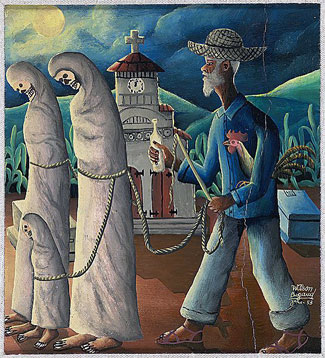
Zonbi
A good priest will have good character. Noone is perfect but they should have a sense of nobility in being trustworthy and be able to control themself and not have knee jerk emotional outbursts,

Vodou altar

You should not set up a table without guidance for the reason stated above. To work with the Lwa that you actually have, under an initiated priest. Be open to the spirits you are guided with and not just because you want this or that Lwa. Just because Erzulie is known for love, does not mean that many other Lwa cannot also perform this work, or want to perform this work for you. Once you have an idea of some, with guidance you can set up a prayer table. This is not the same as the priests altar who have received the spirits in ritual, or have been passed down in an unbroken family lineage.

Certain spirits go specific places, some do not like each other, certain things must always be present. 

Buying a statue is empty plaster, there is no spirit there. A priest does not need a veve or statue to have contact.
People need to start thinking spiritually and not materially.
When you become an initiate it is like an attunement internally, a foundation: pwen or a spirit point. Which joins the body and head to the spirit.
If you buy a statue or a doll it must be blessed or baptised by yourself at least. And it can be a gift or an object of meditation but do not mistake it for the Orisha nor Lwa, nor spirit guide. Do not buy all the Orisha or Lwa oils baths and candles from the botanica, they make a nice gift to the spirit but they are not traditional. Using these things all together is not Vodou. The religion or spiritual tradition of Vodou has its own traditional recipes for making baths and lamps that are passed down and not full of synthetic ingredients. If they are used they are usually added to other things, such as a fixed candle or lamps with other fresh herbs or natural oils. We do use many spiritual waters and perfumes.

Of course dolls and statues or pictures can be prepared as pwen. No pwen: no license or attunement with the spirit.
Spirits cannot be bought. Bought Pwen "Achete" are usually but not always contracts facilitated by the priest. They are the dead, earthbound and intranquil, djabs/demons/devils or Petro spirits usually for hire. They are not usually hereditary.

They must be paid, fed and worked with a certain way or your life can become a disaster.
The rada Lwa need to be fed, and given exchange, but again you either have them, they are interested or not.

Others say no altars in a house that is not really yours or is not a family house. Some altars are set up not to be moved and they are there for life. This is because in a traditional African shrine, the land and land spirits are familial, ancestral. Where you are born and buried are linked to family lineage in the root branches connected to your family lines of spirits.

With a prayer table you've created a sacred space designed to focus your faith and attention on your practice. It is intimate, singular and particular to you and it represents your understanding of your relationship between yourself, and your Lwa trhough the lineage you have approached. It is invested with a tremendous amount of your personal spiritual power, energy or ashe. Offerings and prayers can be given, but they are only vested in you, and not do work besides protection and perhaps occasional small petitions. Big work requires more engagement. and not a simple offering. Do not promise them anything you are not able to fulfill. They can be bargained with possibly.

An altar, on the other hand, has been specially prepared and inhabited by the Loases it was made for. It is also indicative of your relationships with your spirits but is reciprocal. The Vodous are actually in the altar and do more than just receive offerings, honor or veneration. It is working with them instead of only serve. Many confuse the word honor or serve with working or petition. The priest only has or can install this altar to a spirit in person.

Sancista 7 Crossroads


Monday, June 27, 2016

Voudou Divisional Altar Pictures

I am busy with personal work, projects and travel lately, so I may have fewer posts for awhile, and am also finishing up my first book on my tradition.

Here are some pictures of my Voudou divisional altar focusing on my head pot, Metrisili and Candelo Cedife. Enjoy!


 Mothers day:

 Before:
Setup for Sanse coronation:
Court case work:
Metrisili service:
Charging items for La Sirene:

Gracias la misercordia! Thank-you to the spirits for the mercy you bring us!


Wednesday, February 3, 2016

How to read the water glasses and white pillar novena candles on the boveda Part 5


Reading the water glass and candles, Boveda Part 5


Observe the water glass for bubbles which indicates spirit presence and may indicate the request of the spirits. A glass that is clear and full of fine bubbles is what is used in a spiritual bath which cleanses a person spiritually, to better communicate with your spirits, and is full of blessings or is made and prayed over for a specific purpose. This generally prevents negative energetic attachments which can cause many problems such as bad luck, bad health and problems with employment or a relationship. If the bubbles are present after you cleansed yourself over the glass, it could be negative, and that water is disposed of anyways and never used again.

If the glass is used to call a spirit not worked with previously or to remove negative energies, or after you cleanse your home, the presence of a lot of bubbles may indicate negative presences. We go by our feelings and having an established practice, dedicating the glass to our ancestors. 

Large grape like clusters of bubbles may indicate lower level spirits present. This can be one way if you put glasses in the corner of your house to detect negative entities.

A glass of water with bubbles at the top may be requesting prayers,  communication, tobacco or incense. In the middle they may be requesting to come through a medium or the misa environment. In the bottom or middle they may be requiring elevation, white flowers usually kept on the altar before spoiling or food. Sometimes other people's spirits or spirits will be attracted here or to you because they know you can communicate with them or for them, or know that they can get help. This is why lighthouses are sometimes haunted, by spirits of those lost at sea, people that lived there or as a beacon of light. People that do not know they are dead may even go to hospitals even if they never died there.

Some Lwa do not like water whereas other spirits such as the native americans or indios of the river love to have water nearby. In general we keep water glasses next to our ancestors and spirit guides. Burning incense can also help the dead or certain astral  spirits to manifest as well as provide a clearer area. Frankincense and myrrh, copal, and rose are favorites, as well as citrus, sandalwood and vanilla. Some people also like to use palo santo, but we have taboo against burning cedar seen as an emblem of the tree of life.

No bubbles or cloudiness and contaminants in the water may indicate listening to an upset state of mind of the practitioner, spirits cleansing themself, filtering negativity from you, or failure on the part of the practitioner to keep it fresh and communicate, as well as attend to promised duties. However I live in a part of the country where there is a lot of white limescale to the water, which is hard to clean even with citrus agents, but you never want to use filtered water, as the particles help the field of communication. Therefore I usually use one water glass except when doing the water glass arrangements for specific directions to the court. Because I share my white table currently with my spouse there is a lack of room.

It is very common in households to have one altar for the family, especially with several generations in one household, where the house would be passed down in the family and jointly responsible for its condition and use. I do not suggest this if you are unmarried or not “family”, or if one person cannot maintain your separate sections as husband and wife.

Reading Candles

Candles also can be observed for forms the wax makes if it is not a sanctuary or novena type. However this guide is more for the glass novena pillar type, that should be straight at the top.

Scrying the flame as it melts can be done in a relaxed open state, do not try to concentrate. Glance also at the figures such as saint statues or guide statues mouths

 The bottom inside when it is done for patterns and whole of a glass novena glanced at. Figures, initials, numbers are often divined.

Candles should burn clear, If a little black at the top, and the candle has a straight glass chimney such as a 7 day glass pillar novena, it may have caught something negative. If all black, or mostly down the candle glass, there is a lot of negativity present. Cleansing, and more work needs to be done and divined. The same if the candle actually broke and it was not because the wick was close to glass wall. Your spirits caught something negative and protected you. Make sure you trim your wick before lighting. Another candle is burned to see if the situation is cleared. Many people take private photos of their work to document spirit presences and reflections, some of which can only be seen later. Fire safety is important to place them safely and avoid having them burn unattended. Glass candles can crack or break, as a manufacturer flaw or catching a negative vibration. Wax can spill and continue to provide fuel for flame to burn. 


Observe the flame quality, bobbing and waving back and forth can indicate talking so quiet yourself and try to listen. A high flame or crackling indicates strong effort and aggressive spirits or presence, low indicates a hard time achieving the efforts or weak presence. I have read articles on how to read candles some I agree with some of it I don’t. 

Twin flames or more can indicate a quarrel or more than one person or spirit in the situation. Ghosting or a white film on the candle glass can indicate good spirit presence. Excessive wax buildup can indicate trouble or efforts to resolve a situation did not work. Wax lines or ghosting lines on the glass can indicate issues or items the spirit has worked on for you. These can be compared to where you might have written on the glass with a sharpie. You may want to include the date, your birth date and initials when writing on novenas for prayer or special requests. It is not really candle spells, as these are not kept on the white table.

@--^--  S7X

Wednesday, January 27, 2016

The boveda, mesa blanca & The tableau espirituale: Part 2 How to set up the white table

What you will see at a misa, which translates from spanish to mean mass, in a folk seance, is:
 a simple clean white tablecloth on a small table covering the legs that touches the floor. On this table is usually placed a water glass (tap water only) with a metal crucifix inserted, white flowers and white candles along with Allan Kardec's book of selected prayers.

A very simple boveda ancestral altar at home, is like the misa table, which likely also contains pictures and items belonging to loved passed family members. In Sanse they can be a bit more elaborate as we add ours spirit guides, non bloodline dead and more correctly call it a tableau espirituale: a spiritual table.

While one cannot be instructed to hold a misa as a solitary or  untrained community, basic steps can be taken at a home practice.

The white table must be kept uncluttered and as absolutely clean as possible, the water refreshed at least once a week, and when they get cloudy or dirty, whenever flowers begin to wilt they are removed. The table cloth should be laundered at least once to twice a month, or when it begins to get dirty with wax and ash. Monday is the usual day to attend your altar, but as long as you remember once a week. It is not for people who cannot maintain this responsibility. It is a "golden door to the abyss" as I have read, and guidance is recommended, but if you can follow these guidelines you should be OK. Please read part 1 if you have not already.

It usually is kept in a front or a back room, avoid the bedroom as you want restful sleep, or place a screen in front of it as no business, loud conversations, or eating is done in front of it, nudity or sex. You can also cover it with a white sheet.

A closet is not ideal as it is unsafe to have clothing close to candles burning. It is good if you can have sunlight upon it and not in a dark forgotten place.

Before the table is set your spirits should be lifted by a misa, paying for a Catholic mass for the dead (about $15 at a church, or by raising them up with prayers of elevation for 9 days).
You start by using bricks or books from the floor raising the waterglass in height each day, or from the floor to a chair to a dining table to the kitchen counter to the top of fridge etc to higher ground in your house, symbolizing them rising in power, and purifying in light). The last glass needs to be placed higher than your head. Then a glass for the ancestors or a specific ancestor that you are transitioning who passed, if longer than 1 year, can be placed on the table.

The table should not be used, it should be new or from a family member only. The table is cleansed mundanely, both sides and leg with soapy water, and then spiritually with a cologne or rum and smudge such as I use a cigar and florida water on the surface and under the table. A prayer of cleansing and consecration ie dedication is done over the table before the cloth is placed. You can make this up or use the prayer provided. You can bless the table with a gently water cleansed basil leaf bunch by dragging a cross upon the table. You can also mark the 4 corners in this manner if desired.

I wrote this prayer formula, but you can use one from another source which meets the criteria of cleansing and dedication of the altar to specified spirits:
I dedicate this altar to *(the most high god, el santismo), my good helping ancestors and my spiritual guides responsible for my spiritual elevation and progress to be a meeting place of power and peace. I call your names *( ….. or known and unknown) (ancestors who are a positive influence in my life, who guide yet support my choices, and guides known and unknown) to bless and guard this table and myself. I purify this table with (holy smoke of the messenger tobaku, and floral essence, the power of basil etc). I ask for your blessings. I honor, listen, and give thanks for your assistance, light and wisdom. Speak and guide me, I call you always.

*(can say great spirit, papa Bonnye as in my branch of voudou or Bon Dye, the congo: Nsambi, Papa Bon Dios, Toponderosa, father sky and mother earth, whoever you see as the ultimate divine source God and is your spiritual path)
*(list all known keep a book and ask your family members for history and research, you can call them when you do your ancestral prayer. You can keep a list of names or just surnames on the altar if you wish).

Originally the african ancestral altar as far as is remembered to be taught is a stick of the dead, called a palo de muerto, or baston de muerto in Sanse, egun (of the dead proper) stick or bakulu stick depending on african religion. You can get one prepared by an initiate, as they are usually sacrificed over in Palo or Santeria/Ocha/Lucumi. In Lucumi they also have a terracotta or clay roof tile that can be recieved as part of the egun. Sometimes a pile of rocks or a smooth ovoid river rock was used with or without the stick upon an earthen floor or outside where water or libations could be poured upon the ground and a boundary marked with cascarilla chalk.  This would be tapped 9 times on the earth to waken or notify the dead to get their attention. I know in Haiti they sometimes use a stone altar called a Pe along with a water glass. Since people started living in cities they would keep the staff in bathrooms, along with marigolds. The pipes were believed to lead into the earth, and so as well clogged pipes is to be avoided or cleansed as possibly malignant or stagnant energies of the dead. Some will dispose of the altar water outside upon the ground, but down the drain is personally acceptable to me as well.

Symbols of items, and other items which can be placed

The one water glass with cold tap water below the brim: All, spirit, god, the great spirit. Your ancestors will have to share this cup, until your spirit court and guides be investigated in a misa. You could use 3 cups one for maternal one for paternal ancestors and one for God and other spirits. Then you will dedicate the other number of cups to classes, commissions or specific cultural lines of dead that you have, including ancestors of past lives. You need to lift this cup up and dedicate it to "God", and all your good, helping ancestors, willing to support your life choices, and be a positive, healthy influence in your life. The cup must be dedicated, because it is a portal, a vessel like a body for them, and not for random spirits. The number of cups used besides the main one which is the largest usually, will depend on your tradition. We use 9 small and one big, as I was taught to count the glasses around the big one. The number may indicate a particular misterio such as an Orisha you or the group is under if practiced the Cuban way. You will use these other glasses for communication and when you know your spirit court.

The other cups can be placed in different patterns to indicate to the spirits your spiritual needs such as defense or elevation. The one cup or rest position is of peace and a normal defense. Water represents life, juxtaposed with the realm or sea of the dead, and the bubbles within as presence as spiritual gasses or fluids. The water purifies, cools them, and quenches their thirst. You may see the water drastically evaporate even not in the summer months as they drink. I will do a blog post on how to read the water glass and candles in an upcoming post. In this glass a sprig of basil, ceiba, mint, or rosemary or choice of fresh herb can be placed, but the water will likely need cleansing more frequently. The glass should be clear, round, with or without a stem, with no markings or etchings on it.


When the METAL crucifix is within it is the active or ON position when you are working or just need their added presence. You may otherwise place this beside or balanced on the top of the glass. It represents light, life, protection, the intersection of matter and spirit, the world tree and as the poto mitan, axis mundi or palo majeur as the dead come up the roots, the 4 directions or winds, an as an antennae for frequency.

The flowers are fresh and give life. Blessings are conveyed within the petals, if used before wilting in a spiritual bath. Yellow flowers may be acceptable, but preferably white. You can use these for cleansing, or cross them over your body before setting them down. If you cleanse yourself with the flowers or watercup, you should not use it for a spiritual bath later.

White candle: energy like the food which is given. Heat, warmth, elevation in terms of spiritual expansion and progress and light to help them see in darkness and guide their way to the table. It should be placed near the main water glass, and you may place more than one.

The food should also be dedicated to your ancestors welcome to the table or a specific dead. So no hungry random ghosts to eat at your table. Do not give them too much alcohol or food, once a week is enough. In the beginning you may feel candles or food are needed more frequently to help them elevate and progress to a steady place and relationship with you. People usually place this on the floor in front of the altar or on a chair beside. Food can be made the sign of the cross over your body before setting it down, or hold it up to your head or lips, heart then abdomen first.

You can give them tobacco if they smoked, make sure there is a lighter or matches, and you can light cigars, and blow it over food offerings or items to cleanse. Many keep a clean ashtray. You may give them money as a form of energetic currency they can use, which exponentially is worth more on the other side. You can spray the table with perfume, especially healing balms or as a calming influence such as with rose or violet. Florida water is used but you should be aware it can be two handed and manifest both good and bad thoughts ass well as being highly flammable. Pompeya lotion is a more positive and feminine cologne, but I prefer the smell of florida water. Holy water is often kept, but I have a secret procurement. This should not be bought, but can be obtained via donation at a catholic church font.

A bell with help to alert them and raise and break up stagnant energies, this is rung in a cross to open the table or just to notify and balance the energies with a participant under spiritual influence. I will address how to open and work the table next post.

A bowl of blue water is often kept on the floor in a white or clear bowl. This is tap water with laundry bluing such as liquid mrs stewarts brand, bluette, reckitts squares or hoodoo blueballs. Added to this is what suits your psychic fancy at the time, usually a cologne. You can also add white flower petals, cascarilla, holy water, essential oils. Cascarilla represents the white clay layer in Africa representing ancestors, also called efun or pemba. This clean good smelling bowl repels negative dead spirits which rise from the floor. Sometimes a candle is placed therein, as it is protected and designated for good spirits.This bowl of water is often prepared before misa for cleansing participants, or for spiritually cleansing yourself, which you should do in some manner at least once a week on approach.

Do not approach the altar when in a bad mood or swear in front of it as they are a mirror for us, and will attract like spirits and color their manifestations. You can of course confide in them your difficulties and speak as they were there as in life, ask for help, clarity and guidance.

A divinatory item which is cleansed frequently can be used here. This is not used as a crutch but as an addition to mediumship, felt often in the body or other "psychic" senses.

Jewelry you intend to wear, to have their influence upon it as a charged protection such as a cross necklace, evil eye or hamsa, azabache etc

Sharing the altar is only recommended in a family situation or when a couple is good as or married. There must be kept flowers to divide the two sides , along with other items such as the tools in the middle and both responsible for maintaining their side as well as refreshing the table or it will provoke fights in the house. The feeling on the table should be one of peace.

Things NOT to put on it:
Dark colors: black and brown are associated with the more earthbound malevolent dead. Some people also have taboo against red due to the hot or aggressive nature it implies. Keep mostly everything white. Some gold preferably or silver is also acceptable. Try to dress in loose white clothing with shoes off or at least a white shirt when approaching.
Dead or dried flowers
Do not leave food more than 24 hours, drinks can stay a bit longer
Do not give rotten food or anything you would not personally eat, unless it is a type of food preference a specific family member ate in life that you just do not like.
Salt: personal opinion is that it repels dead, or keeps their vibrations lower "trap" unless used for infestation in a house, do not worry about occurring  sodium in products but do not add more to food.
Do not place spellwork here, or anything of negative witchcraft or sorcery as it will impede their and your spiritual progress, being linked. The ancestors are not used for this. You can write petitions or on a novena candle for blessings.
Anyone living lest they join the dead early
Anyone dead known to cause you problems in life, who was/is troubled, including victims of violence and suicides, as well as quasi intentional drug overdoses. These cases should be handled with guidance and investigated by someone who is trained to navigate the situation.
Anyone who has not been dead longer than a year. Usually the guideline is to give them their spiritual sendoff and elevation, then give a period of rest.
Cages: I know this sounds funny but I saw someone untrained do it because they thought the closed birdcage looked pretty. This goes against liberation and progress principles as a symbol.
Anything that does not serve a specific function or need to be there, purer, cleaner, simpler the better
NO gods, no loases/Lwa Orisha, no Ghede, no saints or too many religious items. The religious items used have a metaphoric or dual purpose, and not all your ancestors or dead were christian going back to the beginning of the human race. IF saints are used we only use very specific ones as a principle of light or for very specific reasons such as St Claire or saints coded as a representation of the centinela, the main spirit guide. A rosary, a bible usually placed face down is OK, as they can be dedicated to a specific family member, or such as I have a spirit guided who is a nun who takes these, and are used in ceremony or as a symbol of prayer. Prayer books are OK.
Clutter: simple and clean as possible will promote clarity.
Advanced:
An initiated Sancista will also place around their spirit guides and paraphernalia with the other water glasses, although one who is only an espiritista will generally keep the dolls or statues separate as in the Cuban way. The Cuban way also keeps separate any dead who is not of your immediate bloodline, but in Sanse we allow passed friends, or other personal venerated dead such as passed spiritual teachers to be placed in a specific organizational method.

We will often pin 9 different colored panuelos, bandanas or cloths to the front edge, as the number and spectrum of classes of the dead spirit guides we acknowledge.

You may also see a monstrance, which can be of several designs, representing the sun or light, catholic transmutation of spiritual alchemy or enlightened flesh. Mine has a cup, the bread wafer Eucharist light/earth/body descending into it, and a solar halo around it, and is golden in color. The monstrance is not necessary. Some do not add a cross but critics say there will be a lack of light.

If there are any questions or if I have left anything out please comment or send me a message.

Next blog posts Part 3: How to approach or open and basic guide to work the altar
Part 4 How to read the water glass and novena candle
Part 5 How to do a basic ancestor bath to connect to them and spiritual cleansing


Thursday, December 24, 2015

The boveda, mesa blanca & The tableau espirituale: Part 1 Purpose


The white table practice or mesa blanca is so called for the white table cloth upon the altar used in misa or seance but also at home upon the ancestor altar or boveda in espiritismo or spiritualism. In Sanse, the tableau espirituale or spiritualist table differs from the Cuban boveda in that we also include other dead and spirit guides beyond just our current bloodline ancestors or family dead.


Before I began this path, I wanted nothing really to do with the dead, since they pestered me so as a youth, as well as being somewhat disconnected from my family and family history. I learned its better to be protected as a medium, because the dead will take notice of you whether or not you look for them. To a lot of people ancestral veneration does not seem very glamorous or high level, but it is very foundational in African traditions, as well as traditionally in most indigenous cultures. This connection has purposely been targeted to weaken the family and social structure of community, yet it provides independence, through cultural spiritual power, guidance and strength.

This altar is a sacred space, religious or not, a place of  contemplation, peace, power and stability. The difference is in institutional vs experiential home churches and lived personal daily living aspects and concerns. The official catholic church did not always approve of previous local practices, and certain groups of unsanctioned dead. The white table therefore became a place also to honor those unsanctioned or sanctioned, and placed hierarchy those personally chosen such as folk heroes and freedom fighters. Cuban 19th century criollos with Santeria after war for independence had a lot of dead plus previous customs that had this need, as well as the rest of the Caribbean, Latin America, Mexico and South America. Or you can say around the world where experienced colonization, and in Europe reinvigorated after the Victorian age because of the amount of dead in World War 1.

Our relationship with spirits can be strengthened or weakened by our actions. Colonization, socialization and dominant or popular culture has attributed to our losses of our cultural connections, and the methods to do so such as teaching stories, original language, songs, ancestral record, sacred dances, knowledge of ancestral spirits and gods. We outright may ignore them and deny them and our common heritage and like energies. They need us as much as we can rely on them. They help us to be grounded, address social concerns, and have a spiritual home and family, without them we are lost without anchor or guidance of compass at sea.

Some of the authors spirit court and tableau espirituale:


I will address the guides and the other dead at another time, as the initial focus is of the ancestors.
Part of them remains, their personality, to help us even if their soul has incarnated. The dead are intermediate spirits, such as saints between us and other or higher spirits. As well our ancestors are gatekeeper or permissive spirits to others. The current family line going back generations unknown to beginning of mankind (antepasados), as well as our bloodlines from past lives (difuntos). We can pass this tradition down to the next generation in hope they will assist, communicate and remember us when we have passed from this realm and we, continue to watch over them.These spirit links or chains (cadenas) make us stronger and resistant to being controlled and tell us the truth. Their altar is a microcosm of your life. It can absorb shock of negative energies  and protect you. It can help you feel peace and relief.

Common colloquialisms is without them we are nothing, we stand on their shoulders, we walk the roads they walked, they are in our blood. The ancestors stand behind us or encircle us, whereas our main spirit guide leads from the front or the right side, and other dead and guides on the left of us. They are our first and last defense. They are more invested in and interested in us than most other spirits, and our potential for offspring and possible reincarnation through,but not always along family lines.

  Problems in our lives or misfortune is potentially seen as a need for balance and to appease these spirits. Not all our ancestors are positive influences or agree with each other or our life choices. We can communicate with them and make peace with them, so we are both best served. Sometimes they are so problematic and not ready to be in our lives, therefore we only include loving ancestors and those willing to be a helpful positive influence in our lives to our spiritual or ancestral table. 


As we work with only good and helping ancestors, with their positive influences and advices, being a good person with shared values, such as family pride and respect will help you align with them and what they would wish for you to become. Show them that you respect them, and ask their permission and blessings. They may have very different ideas about what they think you should be doing, such as occupation or religion. Of course we have free will and choice to live our own lives, however some religions and cultures might have been in direct opposition to your cultural group. In ancient or more recent times they may have warred with each other or slaughtered your people, and may be viewed as betrayal. Perspective on the other side is much less limited to ours, however just because our dead have passed doesn't mean that they are now perfect or know everything. Some may have such strong or bigoted opinions or beliefs as they did in life, whereas others may have seen the errors of their ways.


This is especially a problem with fundamentalist Abrahamic religions such as Christianity, who may believe that regardless of your race you should not follow an African or indigenous tradition or religion. You can have factions of ancestors and dead disagreeing with each other and this can play out on the stage of your life and altar. Some ancestors, feeling dishonoured, uncared for, are in need, or betrayed may then very well place obstacles in your path, problems in your life and misfortune. This concept is called osogbo misfortune in the Yoruban cultures, that the ancestors are displeased. However obstacles and difficulties are learning experiences and  may be a way of revelation and freeing oneself from religious burdens placed upon us, possibly since birth.

 We can help those troubled ancestors in another way without having them make problems until they are ready to be in our life. Spirits suffering can be alleviated and help their progression and elevation. Ask God for their elevation and relief, to gain more light and empowerment through intentions and use of prayer. The feeling on your altar should be one of peace, or something is wrong. Assistance, guidance and direction is strongly suggested. Questions about the welfare, or whether or not to include dead family members who died violently or suicide should be approached after one year of resting, with a qualified spiritualist. The dead are generally given a period of one year of rest regardless of situation before approaching.

The white table is seen as a meeting place or conference hall in our homes and life. You can preface your call to your dead as only helpful elevated ancestors are welcome, willing to make a positive difference in your life, yet support our free will and life choices.

Protections: ask them to close the doors to danger of the street, accident and violence, disease, sorcery, ask them to protect your mind, body and spirit, ask them to keep people with bad intentions away from you.
Blessings: ask them for improved and new opportunities in employment and finances, harmony in relations, ancestral issues to be resolved, traumas and problems affecting you or your family line can be healed to make us stronger, ask them to guide you towards the appropriate spiritual teacher, and for good people to come into your life.


 The altar can also be used as a place of spiritual cleansing, and I will address this at another time.

The white candles give spirits in darkness and who are lost the ability to be guided and to see, as well as energy, warmth and light. When you hear EVPs the dead often say I’m cold, I’m hungry, and this table will meet their needs, as well as orient them if they are lost or trapped somewhere. I will teach you how to read the water glass and candle which will indicate their requests.

A fresh water glass full of spiritual fluids presence and blessings

Next blog post Part 2: How to set up the altar
Part 3 How to address and basic guide to work the altar
Part  4 Cleansings
White bath
 Part 5 how to read the candles and water glasses
Baston de muerto: stick altar to the dead