Wednesday, March 8, 2017

The baston de muerto: staff of the dead and ancestors

The original indigenous ways that people honored their ancestors and worked with their dead was not through the white table boveda, tableau espirituale. The white cloth table is from the seance traditions of European mediums in spiritualism, which crossed with folk traditions in the 1900's in Cuba and Puerto Rico.

Originally libations were poured upon the dirt ground. But since in many apartments and temples not being on ground level, people began to modify. Libations were then poured into a bucket, where they could pour outside after, or a few drops of water poured onto a clay tile (teja) in Yoruba faiths in the new world if it is prescribed by your reading. This was kept with an egun shrine near pipes leading to the ground such as in the bathroom or kitchen, usually with marigolds, flor de muerto: flower of the dead. Or was also kept outside by the back door and yard area.

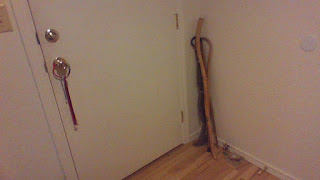
This is also where a Baston de muerto can be placed, and can be indicated that you need to work with the dead this way through your readings, and which type of stick needed for example one or two faces, a skull, or snake can be featured. If the Orisha Oya is suspected to be close to a person, it may be recommended to get a stick or set up a boveda in a certain way. Oya or Yansa is a warrioress of the cemetary gate related to the dead in the new world and the river in Africa, and not death the reaper herself, but she is related to how death, Iku got brought to earth out of compassion, because of suffering, starvation and disease. The stick again is indicated in a reading, and may be relate to the mysteries of earth.

Other names in different traditions for this stick of the dead is Bakulu stick in Palo or Kumangongo. The stick must be taken from nature in a certain way. Sometimes a main staff that is prescribed from a special tree is needed, but the rama of Palo does not have a baston de muerto in their lineage otherwise.

The palo or baton de muerto: Opa or igi egun, pagugu, aumba, although Yoruban faith will add things to this altar like 9 bundles sticks of flor mar pacifico (hibiscus) with a red ribbon and approach their dead a different way than the Palero, Vodouisant or Espirista. The egun stick for eggungun, was the ancestral altar axis mundi, tree, between our world and the worlds of the spirits.
                                                                       From auctions609 store

 It is used for ancestral dead or other dead in the frame mostly and not spirit guides approached through spiritualism who are more elevated. In Yoruban spirituality, egun are the collective dead who are from different sources or types, such as some serve as guardians of a place, or initiatory dead. The egungun are technically also a subset of bloodline ancestors as far as I understand.

The dead are very important for many reasons, and without them there is no Orisha, the saying Iku Loba Ocha, the dead gave birth to the Orisha explains cosmology and from the Odu stories.
                                                artwork by Marietjie Henning

The staff represents the creative generative power of the dead, and as a phallic wand you will see the Ghede Lwa Baron dance with of life and death. It is like a family tree. The wand is like the body of Dhamballa, as Moses turned his staff into a snake. It is generative and spiritual fire of the Ace of wands. Thus some say the baston helps to strengthen the connection with the dead, and male line of ancestors.
                                                                tvtropes.org

In Puertorican Vudu, the staff of the dead is linked to base of the poteau or poto mitan or palo majeur (pillar, Ceiba world tree of the peristyle, caye, badji or hounfor), Papa Loko, and Papa Legba's cane (from us to the Lwa). I keep mine against my boveda, or by Legba's cane at the front door. Likewise we may use a sacred tree for our repository and tie 7 ribbons on it for the 7 Jefe Lwa Misterios of Sanse.

In espiritismo or Sanse: The stick can be placed as an "outside" shrine, or boveda "astral", such as against a strong tree which can serve as your spirit repository. Astral doesn't mean in spanish what we think of in ceremonial magick as a lunar realm. It means outside in nature, or without a physical body. This area is usually marked and consecrated with a border of cascarilla chalk with 9 dashes or arrows. There can be kept ovoid river stones which are special repositories, otanes. To here you can place the items you normally would as a boveda such as white flowers and candles, multicolor bouquet, a sunflower, food offerings such as sweets, coffee, pork, fish, rice, stew, cigars, water, rum overnight.

                                               from ibuocantomi@blogspot.com

The staff is tapped 9 times upon the ground to evoke and give notice, of vibrations to the ground where the dead of the world are connected, while giving orations and prayers and traditional songs to Egungun.
                                                                         
Some in Ocha have taboo on what a woman can do around Egun, such as they did not wear the costume according to pataki stories, they can have the stick but some do not strike the ground with it. The stick also banishes negativity, and some place bells apon the lengthy (almost to the ground) 9 colored ribbons or cloth strips tied at the top to ward off misfortune (osogbo). Some do not place the bells stating it scares off Egun, as there are different types of baston, some are built to remove the dead tapping from one area of the house leading to the outside of the dwelling. Some also just place one red ribbon to mark the staff is empowered by the dead. Can be multicolor beaded. The colored ribbons represent the egun dance dress costume, and as the number of the dead. The stick is straight, true as possible, and can be made of different or a specific type of woods.
Iku is the spirit of death itself
 
Not everyone should have this stick, which needs to be taken seriously. It will also be revealed to you if you are a medium, or have a spiritual court which deals more with the dead. You should have already begun a regular practice to attending to your ancestors.
                                                              army of darkness

However, you do not need to be initiated to get this stick, if you have guidance from a priest. The top can be drilled into, to pack the secrets into it and then sealed by a priest in Ifa with certain types. The stick is washed with different herbs and preperations, dedicated, consecrated, fed (animal blood in Ocha and Palo) and prayed over. 

In Sanse, I do this with various herbs, washing, colognes, and epo (red palm oil) with a service to the dead. But if you are seriously entertaining entry to another tradition than Sanse, I recommend you get one in that tradition, as we are a syncretisation.

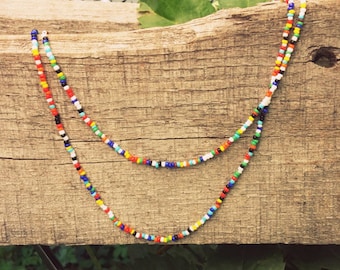
 I have also received my Bakulu ancestor necklace from my godfather, a Palero. In Sanse we also use a multi-color glass or crystal seed bead necklace consecrated to the dead of your court.
Sanse:
We do not use the 7/7 pattern unless you have the 7 african powers as guides or are an initiate of Sanse for Los 7 Jefe Lwa in our house.
These items are sacred and must be cared for. The necklaces are not worn during sleep, in the water, nor during sexual activity, or out at the club, and should be kept in a special place, preferably wrapped in a white satin or silk panel of cloth and put away.


If you would like either of these items, then you can contact our temple and start a consultation and rapport.

                  A qualified Santero, Palero or Espiritsta can make you a Baston de muerto.
                  We currently offer these items to the Bakulu or your spiritual court: ancestors and dead.
Whatever your tradition you receive the stick in, influences where and how you will serve your dead, because these religions have a different group of ancestors spiritually. So a Bakulu stick is not placed at the Boveda.
                     
                  The staff can be used in misa, or in working the boveda in Espiritismo,
                  and marks the officiant in rites to the dead.

                               Sancista 7

                                                            crossroads

Monday, March 6, 2017

Veve are Lineage

Veve are used for many actions.
They are used as a mouth or portal to accept feeding the Lwa. They are a portal through which forces can move, activated by the priest, their tools, and pwen/point/license/access given in initiation or through bloodline and given foundation. The closest english word I could come to is "attunement", alignment and agreement/oath. The spirits within African traditions are ancestors or ancestral spirits that followed a people, a tribe's culture and their land. Through joining a temple you are adopted into their lineage, along with any connections that you have which were somewhat broken (if you do not have an unbroken family line) and can be repaired. Usually temples are a gathering of families or run by family.

Veve and pwen are lineage, from lineages. A pwen also can be held by many things. Veve are passed down in the family and/or through temple lineages for the spirits that are served locally. The Lwa recognize these Veve as signatures, and recognize the priest because we also have these same spirits. My Veve belong to my lineage and I have never seen them publicly. They do have some similarity to other Veve of the same Lwa that other people have.

 If you are using a Veve off the internet or in a book, you are approaching the Lwa through or tapping into someone else's lineage. The Lwa will also expect you to greet them a certain way with songs and the tcha tcha, shekere or asson received by priests or passed down by families. This will notify them of who you are children of if you are branched farther from same roots. It can be thought of as a calling card, signature, or telephone number. Some Veve are created for artistic and not spiritual purposes or value. If you do not use a lineage Veve properly, this may upset some Lwa, or they will not answer.

 You also must be careful, a Veve for Dhamballah I saw on the internet was actually for his Petro version.

Some Lwa do not have Veve. Veve are not the only way we can work with Lwa, since the pwen, access is internal. Therefore we also have no absolute need of statues, representations and images. They help to manifest the energy of the Loases which flow internally through us in physical mediumship.

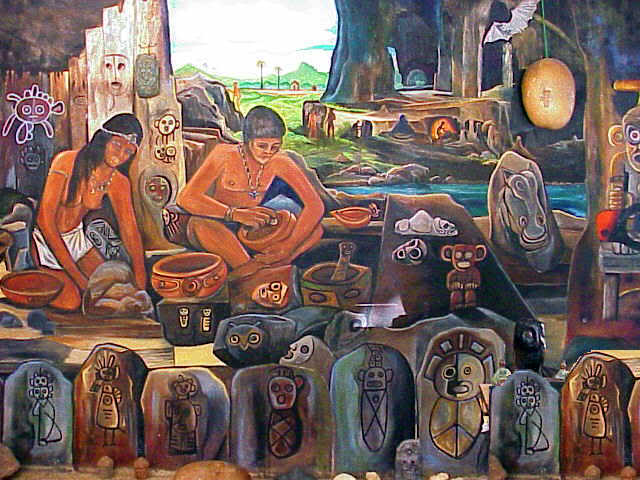
Veve were created in the new world, there were none in Africa. They probably created by Congo influence, indigenous Taino pictograms, and perhaps some European alchemist grimoires and sigils.
Taken from Miguel Sague, from Caney Circle

Public Veve for a type of Marassa Lwa: twins give rise to a third: triplets Petro or child born after
Some of the Veve for the drums also have a tri-medicine wheel motif


taken from palomontenegro

Technically as we salute the 4 directions, this is around the pillar in the temple as center. 
Where spirit and matter interact.

Congo cosmogram, Palo firma/petipemba for the 4 winds and a Lucero. Lucero is the Mpungo similar to the Lwa Legba or the Orisha Ellegua. The cross symbol is prechristain across many cultures. To the Congolisa the cross symbolized Nzambi, God, as well as the earth/universe.
Public Veve for Public Legba

Masonic Symbol: square and compass
Public Ayizan Veve

Public Erzulie Freda Veve

The same symbol can be seen on other veve such as to the loases of various Oguns, Sobo  Bade and Ghede & more

There is a Veve called Milokan (thousands/ mil of camps) which feeds or can call all the Lwa.
 It is a mega Veve in which individual Veve can be seen together. 
This is so no one is left out and has hurt feelings, it is more economical in terms of time, and it can be used to search a solution, or a persons spirits.

Veve have a sense of balance and imbalance that can created for a reason.They can be changed in the moment for specific energy needed.

Veve can be drawn in several materials such as ground corn, and other substances I will not discuss and sometimes for specific Lwa. I have never seen certain substances we also use mentioned in public. There has been some others mentioned in public such as wood ash. brick dust, gunpowder and wheat flour. The substances used are depending on the purpose of ritual and the Lwa being called. They can be traced in the dirt or sand with a stick or informally they can also be drawn in chalk but not traditionally. They are made by bending at the waist and pouring the material, not by kneeling or sitting. They can be danced over, and are usually scrubbed or washed over after the ritual is over.
                                           From Enchanting Scores

Veve have symbols that can be read, and contain usually the crossroads of Papa Legba, the Lwa spirit who for the most part, opens the way to the other rada Lwa. The veve also may contain other images such as tools, weapons, stars, points, crosses, and initials. There are points on the Veve on which certain items are placed such as plates of food, sacrificed animals in other lineages, candles and other things.

Different African tribes and people mixed in the new world to create different traditions and lineages, in Vodou we are predominately west African in spiritual heritage. Therefore we each have our own spirits, and ways of working with them. We do not use the firmas or petipembas from Palo which is Cuban and Congo based, nor do we use the ponto riscado as in Quimbanda in Brazil. Lucumi does have some symbols but they are also very different.

I hope this has helped your understanding of Vodou & Veve lineage!

Sunday, February 26, 2017

Colors & the panuelos or bandanas in Sanse & Espiritismo


White:all elevated spirits, the dead, cooler older rada Lwa, main color of clothing and mesa blanca the boveda ancestral altar, tableau espiritual if you hold it for guides, and the divisional altar for the Lwa. I have another blog entry that talks about white in relation to purity, spirit/bone and the shells, cascarilla chalk.

You can watch my youtube video below where I talk more about the fabrics.
:

                                         The Vodou Altar: 7 panels

Vodou
Misterios, Chief Lwa
7 color: & chief Lwa of Sanse
Papa Legba: white and red
Candelo: red and white or red and black
Beli Belcan: red and green
Ogun Balendjo: red and blue
Tindjo Alawe: green or pink and green, blue for Indio river spirits
Ghede Limbo: purple and white
Metresili: Pink and white, some use light blue

Some of the Lwa under them, or these Lwa color can change depending on point, or vuelta, turn f the spirit or different path of the spirit.

Orange: female Lwa of sweet waters
Red: generally Petro and Congo, and warrior spirits
Yellow: Cachita Tumbo, Anaisa, Oshun depending on path of the spirit, female Metressas of sweet waters, river, Gran Solier
Blue: Marine spirits, Indio of river, Ocean Spirits like La Sirene and Agwe

Espiritismo

The white table, boveda ancestral altar and tableau espirituale uses 9 panels.

Blue is the color of the waters, astral, mental realm, and the healthy energy bodies together are a white or blue color.

The muertos
9 color: the dead, emissaries, ancestors and guides, or multicolor
7 color for 7 african powers: 1 color for each tribal spirit of the dead, celestial number
Their color can also be the mysterio or elements they work with
red: congo
red/black: gypsy but any color they desire, patterns polka dots
africanas/madamas: under the misterio they are with such as blue: yemaya/olokun, red:chango, yellow:Oshun etc
orange: asian spirits
marigolds: flowers of the dead, flor de muerto
yellow, white: spiritualists, priests, nuns
green: indians, arabians with black
blue:mariners

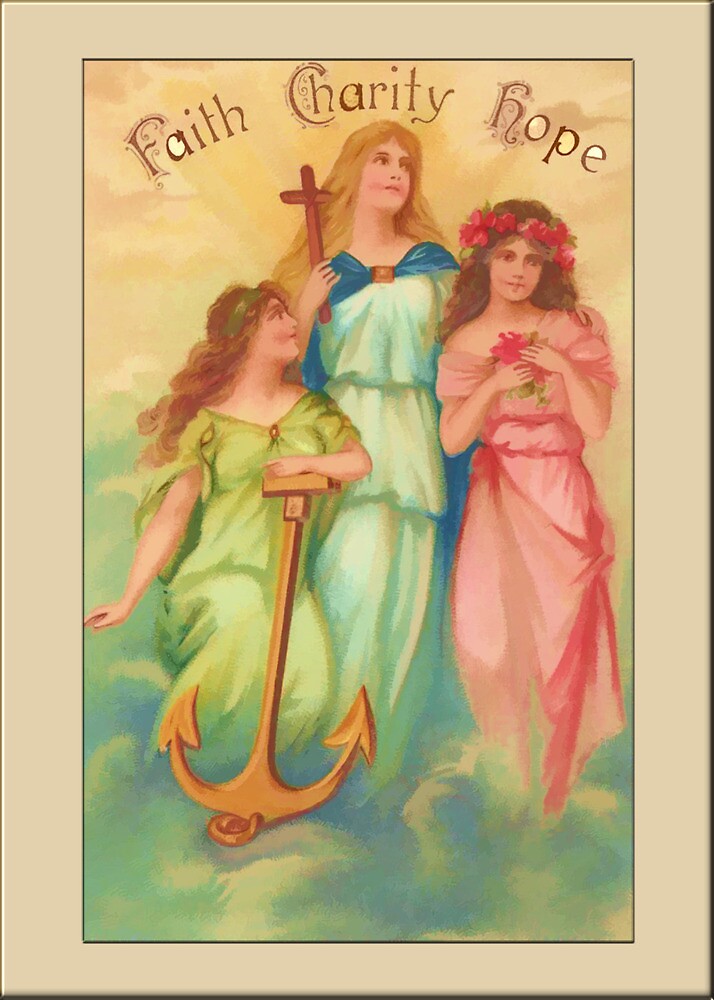
Hope Faith Charity: yellow/green, blue, red/pink the primary color as the 3 powers/potencias
or the 3 races, potencias as well as red, black, white


Cordon & flowers colors


white: peace, calm, purity: daisy, lily, carnation, rose etc

red: passion, energy, strength, faith, power and belief, for those who suffer
pink: :salvation and help for souls rose, carnation etc, charity with heart

orange:humility and bulgarian rose

yellow: strong yellow: light elevation for incarnated souls and ascension for ancestors, difuntos (dead) sunflower, daffodils, rose etc
light yellow: love, fraternity, friendship. charity

green: hope with the anchor
blue: calm, union, reunion, communication, against division, faith with the cross

purple: forgiveness, pardon, grief
multicolor: reunion of souls, against division of people, and division internally or within your house

Reference: El espiritismo de cordon by Martinez & Sablon (2000)

The flowers also have symbolism, not only in their scent and effects, for example: lily feminine and purity.


Monday, February 20, 2017

Plant spirits, work, and the world of messangers

In this modern age, practitioners for the most part do not wildcraft and grow every plant that we work with.

This leads to a disconnect between us and nature, the land and its spirits. In the ATR's we are monotheistic but also animistic, believing spirits live in most everything. The plants are viewed as being part of the body of the sentient earth and spirits of the land.

When the plants are harvested, we respect, and give an offering to the plant. Some give 3, 5 coins, or a crystal, as it is really energy you are exchanging. You can sprinkle cornmeal and give a word of thanks after explaining why it is you need to use the plant for help. I like to give water to wild plants, or do some weeding so it can have sun, seems more practical, and also only take which will not harm the plant from continuing to grow. You can bring extra plastic bags to also clean up trash around the area to show respect.

In our traditions we have a major spirit over the individual plant spirits.There are herbs belonging to various misterio. For example, in Palo: Brazo Fuerte has the plant Tartago (or tatago). But then there is the Mpungo who owns all wild plants Ozain. This spirit must be honored when you wildcraft in their tradition. Plants may only be cut at certain times, unless you know this mystery.

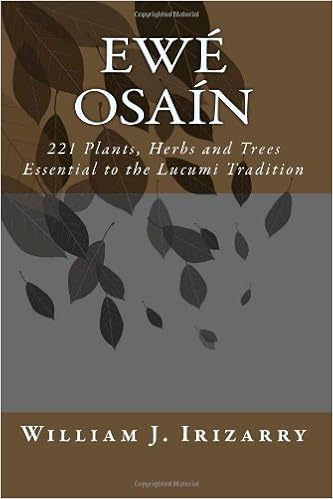
There are other considerations of plant philosophy such as the place it is growing such as a mountaintop versus a cemetary. Other ideas such as if you harvest it in the shade or sun side, what color the plant is white or black/purple. What the plant name sounds like, if the plant is bitter or sweet will determine if it is hot or cool, attractant or banishing, medicinal or poison. Plants are worked differently tradition to tradition, although there is some commonality. Plants have latin, lucumi, english, and spanish or creole nicknames for the same thing. Some of these plants are local and tropical and have no named scientific taxomy. We must get to know what is local to where we live, although some special plants must be shipped overnight for more important events and objects as tradition. This is one good reference material:


Ozain became an Orisha Osain after the Congo and Yoruban people continued to interact. He then came under the Nago nation as Ogun Osayen o Osayin as a Lwa in Vodou. Osain is very powerful, and has its own complete tradition that is similar to Palo. We cannot do much in these religions without plants, and as he controls the power of these plants as a forest (monte) spirit, is a great ally: a dangerous warrior and protector. There is the Mpungo Ngurunfinda, (finda/herbs) who is like a branch of Osain, and like our tree Lwa Gran Bwa, since palo is the spanish word for stick.

In Vodou, we have Gran Bwa (Grand or Big Wood), the Lwa of the biggest tree, usually near the center of the forest. He holds all wild plants. He also is associated with the mapou, called the Ceiba pentranda,  mapok, Iroko, silk cotton world tree. The saint used is St Jude or St Sebastion as he is Petro. An offering is usually given also at the natural entrance to a wild area of the forest or jungle to seek permission ( and listen to the response) and safe travel in their realm. Gran Bwa only takes water, leaves or vegetable food offerings. He is an initiatory (one of several) and permissive spirit.

Both Gran Bwa and Tobaku can be seen like our leaf faced "green man" Oak or Holly God as those have in Wicca.
Gran Bwa, the staff of Papa Legba, the cane and cross of the Baron, Loko and the poteau mitan or palo majeur pole in the Vodou temple are all related, on which Dhambala, or a pair of snakes are often painted. Spirits travel up and down this access point of the world. The royal palm tree is another common holy tree substitute and are both important plants, although different Lwa have their favorite tree. We usually tie 7 different colors on our tree and staffs as this same symbol of the creational snake Lwa (white/green and rainbow) and 7 chief Lwa of Sanse.


In our lineage, Tobaku (Tobacco: nicotania rustica) has become Lwa, because he is a sacred cemi spirit of the Taino indians, and a very important messanger totemic plant. His powers are healing, but disease when misused. For that reason only cigars or natural leaf are used and not cigarettes. His powers are purity, spirit communication and domination.We work with him in conjunction with the 4 winds, because the smoke and prayers rises up on our breath, and disperses our messages and creates community when shared. Tobacco contains compound which altar the mind, and our psychic perception of time and space for "shamanism". We use cigars for folk magic, divination, and to communicate with the dead in misa. Our breath in and out joins the spiritual and mundane realms. Many spirits like a cigar as an offering, such as Lwa or ancestors, and some female spirits as well or perhaps a cigarette.
Tobacco is a master and teaching spirit, such as many view cultural psychedelic entheogens of ayahuascha or certain mushrooms. These are very spiritual and not recreational, associated with the land, and snake spirits. Tobacco workers who are curandero, indigenous plant healers are called tabaqueros. Tobacco is used in Cuban traditions, Espiritismo and groups such as Maria Lionza in Venezuela is the most similar than the other ways used by Amerindians. There are many oracions or prayers to work with the spirit of Tobacco, most of them in spanish, or in booklets from botanicas. Working with tobacco can be a practice in itself in how you honor, ask permissive, offer, ritual observances and divine or work with it. I always advise people to start collecting a book of prayers that you like. In Haiti a natural healer is called a medicin fe, leaf "doctor". Whereas a worker more uses the aspects for "spells", but both may employ both methods and work spiritually.

Prayers taken from Sancista Luis blog sanseespiritismo, that I use often:
http://sansespiritismo.blogspot.com/2011/10/tobaccomancy-tobacomancia.html
PRAYERS TO THE SPIRIT OF TOBACCO


To the Spirits of the Four Winds, Black horse, white horse, red horse, and brown, you that find yourself in the four Corners of the Universe. Above and below and in the Four Directions. I call to you oh Charitable Spirit of Tobacco, ancient messengers of the Omnipresent One. I offer you in homage to the Guardian Spirits of (name(s). For wherever I go with this sacred smoke, you shall purify and cleanse. You shall remove any and every, seen and unseen negative vibration that surrounds (name/us.). And with the grace and power that the Holy Trinity has bestowed upon me, I (name.) purify and cleanse (name(s.). So be it, Amen.

PRAYER 2


With the permission of God.
With the guidance of the 21 Commissions of Spirits and the protection of my Guardian Angel.
With the watchful eyes of my Spirit Guides.
As above so below, and in the four directions, and to the Charitable Spirits of the Four Winds that come from the four corners of the universe. I ask for health, stability, and peace.
May the fluids of the Spirits that speak through the smoke of this sacred tobacco, be beneficial towards me and my cause. May all malice and deceit depart and scatter as the smoke does scatter, and only good and charity shall prevail. Amen.


If a plant was grown by humans, agricultural spirits like the Lwa Azaka or the Orisha Oko have domain. These are earthy spirits, originally most tribes were hunter gatherer before they settled and became agricultural. Azaka Mede is pictured as Saint Isadore.
One Mambo stated that each Lwa are given offerings before gathering their corresponding plants. In our lineage this can be done, but more often with Gran Bwa. Basil is another very important plant and is very common to be present at rituals. For Harvest and planting offerings and feast dates are acknowledged with services for Azaka and for the other Lwa such as the Mange Yam for good prosperity and fertility as well featuring the Nago nation and Simbi, Or such as Mange Lwa to feed the Lwa or Mange Mo to feed the dead and Ghede.

The natives knew much of their medicinal knowledge by the plant spirits teaching them. We have many healing spirits who are: Lwa, spirit guides of nuns or doctors, the indigenous folk healers and indios, as well as saints.They may work with closely several plants. Faith also is very important. They knew of medicinal value, but when not available, faith healing with any plant externally is possible in spiritualism.

When we get a plant from the store, the plant has not been spiritually harvested or grown. The plants are usually sold dried outside of Cuban botanicas when we should use fresh, for more plant spirit life force and vibrancy, more power. Some dried plants, the spirit is dead and gone. Sometimes we can activate some of its latent power, but fresh is always best. The plant is not the spirit, but the spirit is in the plant. Of course some are used dry such as cured tobacco leaf, or in making oils.

God gave these plants to humans as gifts, and their powers were given to these spirits as their gifts. One way we appeal to these plants and venerate is to, in our prayers ask for their power or specific qualities and recited abilities which God has bestowed upon them. We reward and further empower these plants by asking their light, elevation and spiritual progress of God for their work and kindness.

In this way, if we light the plant a candle and waterglass, We can sit with them in communication and understanding to make a relationship. This is how you get to know your plants, besides studying from a book. You have to know how to use plants safely, parts of certain plants can be ingested, or smoked in a session to gain a physical bodily understanding, and connect with their powers. They are used to prepare objects, as incense, anointing oils, washes and baths.

This was once understood more widely in Hoodoo and Conjure, that the plant is not just an ingredient, but an entity to be worked.

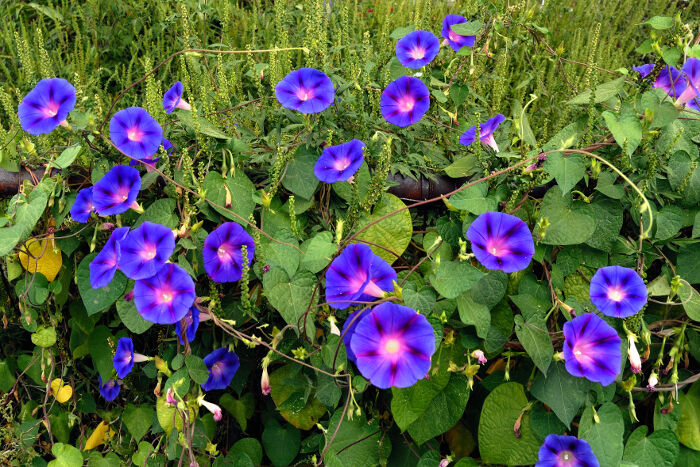
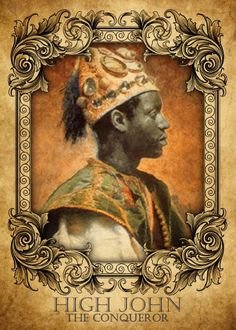
High John the conqueror was rumored to be the son of  a Congo king who was enslaved in the new world and jumped into the root of the morning glory flower plant. Some say he "returned or died" to Africa and left some power in the root. He was known for his intelligence and ways he outsmarted his slave master. Many people take no time to talk to and get to know High John. High John has recently lamented this to us. He is a sorceror and a magician, known for his Congo witchcraft or folk magic. He can do all things as a master root: luck, gambling, court case, love, money work, sexual prowess, success, protection and domination. A very generous spirit who loves to work. The root has larger male and female pieces and both can be put into a mojo bag like a pair of lodestones. In hoodoo and folk magic selected psalms are usually used with the work, depending on what your focus is. an oil using this root can be used on a novena candle, or fixed inside.
Fresh root is better, and should not be crumbling or dried out. Some dress the root with oil, or keep it with ginger slices to energize him and keep it fresh. You can learn more here. There is much to learn about rootwork in general, as an entire tradition.

Prayer to High John the Conqueror:

May Almighty Powerful God,
And the soul of John the Conqueror
Watch over and show me
the way to overcome obstacles, to conqueror fear and my enemies known and unknown.
Lend me your strength so that I can have success in my life,and achieve my goals. Amen

Garlic is another very important plant. Ajo or aho macho is the male garlic, the little round bulbs you usually see at a mexican store, and not the grocery. All garlic has similar properties of fire, cleansing, protection and exorcism, but the male has added masculine virility and warrior properties. The husks can be burned as a smudge. Garlic is high in sulfur and ammonia, known for purification, and against energy vampires or the evil eye. Many cultures hung decorative garlic braids and such as the Italians chili peppers as protections.
                                             el diaro, male garlic

Novena prayer to Miraculous Garlic:

You who were placed on Mount Calvary where Jesus died to give eternal light and to free us from evil; free me from jail and from all demons. When my enemies plot to kill or hurt me, let not their eyes see me nor their feet reach me. Don't let their hands touch me, their guns shoot me or their knives hurt me. Let no harm come my way.
Miraculous Garlic of goodness, separate me from the enemy. Remove all envy and jealousy. Help me in my work and in all my affairs. Grant me the love of those around me. So shall it be, and so it is. Amen 

                                                                       XSancista7X


Thursday, January 26, 2017

Mama Juana: Dominican and Taino Indio spiritual & medicinal drink

Mama Juana (or mamajuana) is a drink from the Dominican Republic that is concocted by allowing rumred wine, and honey to soak in a bottle with tree bark and herbs.The specific herbs that make up Mamajuana were originally prepared as a herbal tea by the native Taino Indians; post-Columbus, alcohol was added to the recipe. Besides being rumored to be an aphrodisiac, with many natives of the Dominican Republic claiming that the drink has similar effects. The Taino live throughout the caribbean of Haiti into Cuba and Puerto rico, as well as Florida.

Mamajuana is also consumed for its purported medicinal value. The alcohol is said to act as an extract base that pulls the herbs' curative properties, creating an herbal tincture often served as a shot. The reported positive effects on health vary, ranging from a flu remedy, to a digestion and circulation aid, blood cleanser, sexual potency, kidney, gallbladder and liver tonic. The tonic can be used to cleanse internally of any witchcraft and poisons. For arthritis, autoimmune disorders, and against cancer if anamu is added. Diabetes also with the cinnamon. It is warming, often used in winter and at Christmas, as well as an offering to the Taino indian spirits. Of course do not use when pregnant.


Method: soak bark/leaves in red wine for 5 days, and then pour it out. You can aso soak with rum or some do with hot water. Discard the liquid after a few days and then follow your rum, wine, and honey recipe. By doing this, the initial bitterness is released from the bark/roots, making for a more drinkable first batch.It also removes any mold, dirt or bacteria.Then, mix dark or white rum an wine(90%) and honey(10%) and pour that combo into the bottle. Let this sit in a dark place for 2 weeks to cure. Shake it up to get the bark/leaves taste, and then adjust to taste, as some prefer strong and some prefer sweet. The locals also said that it will last for years, even a decade...so not to worry about it going bad. You can refill with alcohol 15-20 times to make more batches.

I drink straight as a shot, but some sip with an iced cola soda.
  • Mamajuana is available in two ways:
  • prepackaged dry ingredients, or plants procured, which the customer prepares
  • dry batches are not allow through customs in different regions, bypass this by adding rum to it when travelling and place in checked bag.
  • ready to drink, filtered and bottled

I prepare mine spiritually, with rum, wine and honey, usually with these herbs: anamu, cinnamon, very small amount anise and clove (I hate the taste of licorice), cats claw, palo brazil, pega palo, milk wort, I may start adding a small amount basil as many spirits love it and it has many health benefits, and not to interfere with the taste.

    Fill your bottle over 1/2 full with about 7 of the following herbs, roots and sticks:
    • AnamĂș (Petiveria alliacea) guinea henwood
    • Anis Estrellado (Illicium verum) anise
    • Bohuco Pega Palo (Cissus verticillata) hitting stick
    • Albahaca (Ocimum basilicum) basil
    • Canelilla (Cinnamodendron ekmanii): rosewood
    • Canela de tierra: cinnamon
    • Bojuco Caro (Princess Vine)
    • Bojuco de Palo China China root
    • Bojuco de Palo Indio Chew stick
    • Bojuco de Tres Costilla Basket wood
    • Marabeli (Securidaca virgata) Milk wort
    • Clavo Dulce (Whole Clove)
    • Maguey (Agave spp.) leaves and sticks (cleansing and sweetness)
    • Timacle (Chiococca alba) west indian milkberry
    • Manzanilla: Chamomile
    • Guauci: Minnieroot
    • Osua: bay rum tree
    • Palo brazil: brazil wood
    • Raiz de coco: coconut tree root
    • Una de gato: cats claw
    • Button weed
    • Cornutia

    • In addition to the above standard recipe, it is common for individuals to add other ingredients such as; raisins, strawberry, molasses, and lemon or lime juice. 
    •  Another popular ingredient is the addition of mariscos (shellfish) such as conch, octopus snails and even the private parts or grated shell of a sea turtle! Undoubtedly the combination of these ingredients would provide mamajuana with its aphrodesic powers. 


    Sancista7X