Showing posts with label dominican. Show all posts

Monday, February 23, 2026

11 World Lineages of Voodoo, West African Practices

 The are the current known World Voodoo Lineages Many traditions of "Voodoo" do not call themselves that, here are the names and origin places of ongoing West African practices. I have put the music instrument to denote some lineage.

1  Asogwe  Asson lineage "Haitian Vodou" Haiti, especially near the capitol Port au Prince

They will call their tradition Ginen or Sevis Lwa,Serving the Lwa: Mambo/Manbo or Houngan Priest/Oungan


2 21 Divisions: Dominican Republic, preserve nations of spirits as tribes in the new world from Africa

Use of Saints may feature more prominently, Mama Mambo and Papa Lwa


3 Tegare Tigare / Nana Priest, some djinn magic merged with Islam, masculine Nana priest


Akan have Komfo Priests, Tron: Wami Wata, may have Hindu Syncretism, 

Ewe, Mina, Fon: In West Africa Togo Ghana Benin Nigeria, 

Vodoun, Use Shekere


4  Sanse: Puerto Rico, Sancista, with Espiritismo Spiritualist Seance Tradition Tcha Tcha/Kwa


5 New Orleans Voodoo, Louisiana Voodoo, USA, 

Vodouisants/devotee and family practice/

Expats from other Vodou etc African practices settled mostly here and on the eastern seaboard from NY to Florida then to a lesser extent SE and South


6 Gullah Geechee people : Florida, South Carolina, Georgia: USA


7 Family /Lakou yard Baptismal style Tcha, Haiti especially in the North, Dominican Republic. Root traditions such as Souvenance, and other formative pre revolution groups.

8 Haitiano "Cuban Vudu" via Oriente East Cuba and Havana Kimbisa/ Maraca/Tcha due to the absence of gourd but with same 3 drum set as Haitians


9 Offshoot maroon society such as SanPwel, Bizango, Makaya/practices, Zobop etc: Haiti


10 Winti : West African origin: Suriname South America


11 There was preserved a line of Dahomey Voudoun "Orisha"into Yoruba based Santeria such as the family of Babaluaye, Nana Buruku, and Nanu are usually given together and Orisha names also given instead of Ellegua is given also Afra/ Eshu Afra, Afrakete instead of Yemaya etc 

The Awan basket cleansing ceremony done at Olokun and Babaluaye reception are done. Cuba via Ifa /Santeria/Ocha priests are Santera/Santero or for Ifa masculine Babalwo


Honorable Mention:  Quimbanda where I believe it is the spirit Exu Marabo is said to have retained West African Islamic Male line under Ochosi (seen as mixed-native heritage sort of like Nsasi/Siete Rayos in Cuban Palo) which is why under mixed people in the new world he rules some appearance of tribe division from the kingdom of Lyre and associated crossroads. While Umbanda/Candomble and associated Quimbanda have spirits under Yoruba and mainly spiritualist/Congo influenced. There were conversion in Africa of Muslim and Congolese Christians before Transatlantic slavery to Brazil 


Contact: Sancista7crossroads@gmail.com for Consultations or to add/edit to this List


Monday, March 6, 2017

Veve are Lineage

Veve are used for many actions.
They are used as a mouth or portal to accept feeding the Lwa. They are a portal through which forces can move, activated by the priest, their tools, and pwen/point/license/access given in initiation or through bloodline and given foundation. The closest english word I could come to is "attunement", alignment and agreement/oath. The spirits within African traditions are ancestors or ancestral spirits that followed a people, a tribe's culture and their land. Through joining a temple you are adopted into their lineage, along with any connections that you have which were somewhat broken (if you do not have an unbroken family line) and can be repaired. Usually temples are a gathering of families or run by family.

Veve and pwen are lineage, from lineages. A pwen also can be held by many things. Veve are passed down in the family and/or through temple lineages for the spirits that are served locally. The Lwa recognize these Veve as signatures, and recognize the priest because we also have these same spirits. My Veve belong to my lineage and I have never seen them publicly. They do have some similarity to other Veve of the same Lwa that other people have.

 If you are using a Veve off the internet or in a book, you are approaching the Lwa through or tapping into someone else's lineage. The Lwa will also expect you to greet them a certain way with songs and the tcha tcha, shekere or asson received by priests or passed down by families. This will notify them of who you are children of if you are branched farther from same roots. It can be thought of as a calling card, signature, or telephone number. Some Veve are created for artistic and not spiritual purposes or value. If you do not use a lineage Veve properly, this may upset some Lwa, or they will not answer.

 You also must be careful, a Veve for Dhamballah I saw on the internet was actually for his Petro version.

Some Lwa do not have Veve. Veve are not the only way we can work with Lwa, since the pwen, access is internal. Therefore we also have no absolute need of statues, representations and images. They help to manifest the energy of the Loases which flow internally through us in physical mediumship.

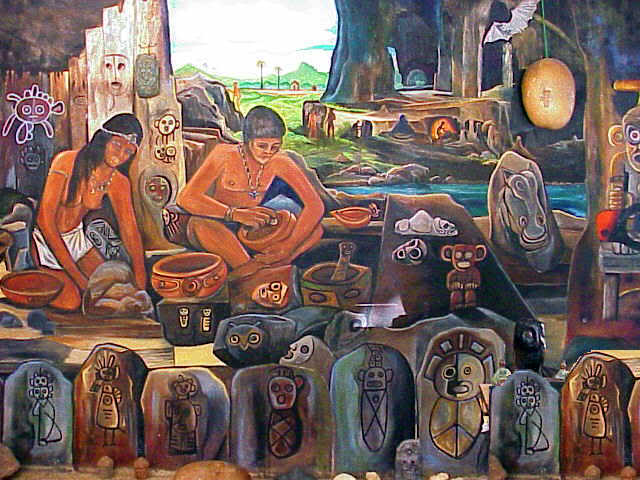
Veve were created in the new world, there were none in Africa. They probably created by Congo influence, indigenous Taino pictograms, and perhaps some European alchemist grimoires and sigils.
Taken from Miguel Sague, from Caney Circle

Public Veve for a type of Marassa Lwa: twins give rise to a third: triplets Petro or child born after
Some of the Veve for the drums also have a tri-medicine wheel motif


taken from palomontenegro

Technically as we salute the 4 directions, this is around the pillar in the temple as center. 
Where spirit and matter interact.

Congo cosmogram, Palo firma/petipemba for the 4 winds and a Lucero. Lucero is the Mpungo similar to the Lwa Legba or the Orisha Ellegua. The cross symbol is prechristain across many cultures. To the Congolisa the cross symbolized Nzambi, God, as well as the earth/universe.
Public Veve for Public Legba

Masonic Symbol: square and compass
Public Ayizan Veve

Public Erzulie Freda Veve

The same symbol can be seen on other veve such as to the loases of various Oguns, Sobo  Bade and Ghede & more

There is a Veve called Milokan (thousands/ mil of camps) which feeds or can call all the Lwa.
 It is a mega Veve in which individual Veve can be seen together. 
This is so no one is left out and has hurt feelings, it is more economical in terms of time, and it can be used to search a solution, or a persons spirits.

Veve have a sense of balance and imbalance that can created for a reason.They can be changed in the moment for specific energy needed.

Veve can be drawn in several materials such as ground corn, and other substances I will not discuss and sometimes for specific Lwa. I have never seen certain substances we also use mentioned in public. There has been some others mentioned in public such as wood ash. brick dust, gunpowder and wheat flour. The substances used are depending on the purpose of ritual and the Lwa being called. They can be traced in the dirt or sand with a stick or informally they can also be drawn in chalk but not traditionally. They are made by bending at the waist and pouring the material, not by kneeling or sitting. They can be danced over, and are usually scrubbed or washed over after the ritual is over.
                                           From Enchanting Scores

Veve have symbols that can be read, and contain usually the crossroads of Papa Legba, the Lwa spirit who for the most part, opens the way to the other rada Lwa. The veve also may contain other images such as tools, weapons, stars, points, crosses, and initials. There are points on the Veve on which certain items are placed such as plates of food, sacrificed animals in other lineages, candles and other things.

Different African tribes and people mixed in the new world to create different traditions and lineages, in Vodou we are predominately west African in spiritual heritage. Therefore we each have our own spirits, and ways of working with them. We do not use the firmas or petipembas from Palo which is Cuban and Congo based, nor do we use the ponto riscado as in Quimbanda in Brazil. Lucumi does have some symbols but they are also very different.

I hope this has helped your understanding of Vodou & Veve lineage!

Thursday, January 26, 2017

Mama Juana: Dominican and Taino Indio spiritual & medicinal drink

Mama Juana (or mamajuana) is a drink from the Dominican Republic that is concocted by allowing rumred wine, and honey to soak in a bottle with tree bark and herbs.The specific herbs that make up Mamajuana were originally prepared as a herbal tea by the native Taino Indians; post-Columbus, alcohol was added to the recipe. Besides being rumored to be an aphrodisiac, with many natives of the Dominican Republic claiming that the drink has similar effects. The Taino live throughout the caribbean of Haiti into Cuba and Puerto rico, as well as Florida.

Mamajuana is also consumed for its purported medicinal value. The alcohol is said to act as an extract base that pulls the herbs' curative properties, creating an herbal tincture often served as a shot. The reported positive effects on health vary, ranging from a flu remedy, to a digestion and circulation aid, blood cleanser, sexual potency, kidney, gallbladder and liver tonic. The tonic can be used to cleanse internally of any witchcraft and poisons. For arthritis, autoimmune disorders, and against cancer if anamu is added. Diabetes also with the cinnamon. It is warming, often used in winter and at Christmas, as well as an offering to the Taino indian spirits. Of course do not use when pregnant.


Method: soak bark/leaves in red wine for 5 days, and then pour it out. You can aso soak with rum or some do with hot water. Discard the liquid after a few days and then follow your rum, wine, and honey recipe. By doing this, the initial bitterness is released from the bark/roots, making for a more drinkable first batch.It also removes any mold, dirt or bacteria.Then, mix dark or white rum an wine(90%) and honey(10%) and pour that combo into the bottle. Let this sit in a dark place for 2 weeks to cure. Shake it up to get the bark/leaves taste, and then adjust to taste, as some prefer strong and some prefer sweet. The locals also said that it will last for years, even a decade...so not to worry about it going bad. You can refill with alcohol 15-20 times to make more batches.

I drink straight as a shot, but some sip with an iced cola soda.
  • Mamajuana is available in two ways:
  • prepackaged dry ingredients, or plants procured, which the customer prepares
  • dry batches are not allow through customs in different regions, bypass this by adding rum to it when travelling and place in checked bag.
  • ready to drink, filtered and bottled

I prepare mine spiritually, with rum, wine and honey, usually with these herbs: anamu, cinnamon, very small amount anise and clove (I hate the taste of licorice), cats claw, palo brazil, pega palo, milk wort, I may start adding a small amount basil as many spirits love it and it has many health benefits, and not to interfere with the taste.

    Fill your bottle over 1/2 full with about 7 of the following herbs, roots and sticks:
    • AnamĂș (Petiveria alliacea) guinea henwood
    • Anis Estrellado (Illicium verum) anise
    • Bohuco Pega Palo (Cissus verticillata) hitting stick
    • Albahaca (Ocimum basilicum) basil
    • Canelilla (Cinnamodendron ekmanii): rosewood
    • Canela de tierra: cinnamon
    • Bojuco Caro (Princess Vine)
    • Bojuco de Palo China China root
    • Bojuco de Palo Indio Chew stick
    • Bojuco de Tres Costilla Basket wood
    • Marabeli (Securidaca virgata) Milk wort
    • Clavo Dulce (Whole Clove)
    • Maguey (Agave spp.) leaves and sticks (cleansing and sweetness)
    • Timacle (Chiococca alba) west indian milkberry
    • Manzanilla: Chamomile
    • Guauci: Minnieroot
    • Osua: bay rum tree
    • Palo brazil: brazil wood
    • Raiz de coco: coconut tree root
    • Una de gato: cats claw
    • Button weed
    • Cornutia

    • In addition to the above standard recipe, it is common for individuals to add other ingredients such as; raisins, strawberry, molasses, and lemon or lime juice. 
    •  Another popular ingredient is the addition of mariscos (shellfish) such as conch, octopus snails and even the private parts or grated shell of a sea turtle! Undoubtedly the combination of these ingredients would provide mamajuana with its aphrodesic powers. 


    Sancista7X