The Lucumi and Congo cauldrons, not Espiritismo or our caldero espiritual
There has been much misunderstanding of the caldero espiritual in espiritismo, which IS NOT an nganga nor an Ogun pot. They may look very similar, but they are made differently and serve completely different functions. People may laugh and say its an invention, but it has become part of Espiritismo occasionally in more recent times, even if it can be described as quasi "bootleg". Please I mean no offence to anybody.
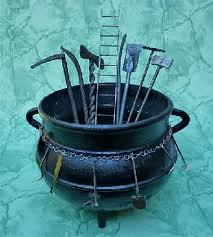
Ogun is the Orisha spirit responsible for war, technology and smithcraft
taken from the seven worlds
photo Ogun fundamento above from Santeria Church of the Orishas
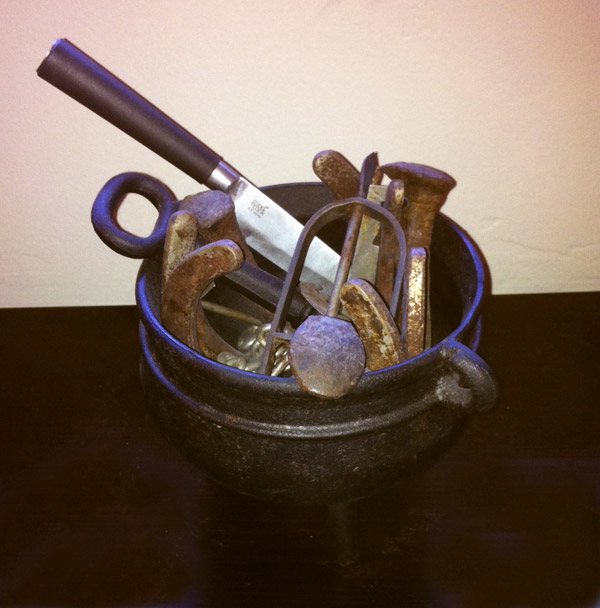
This is received with the warriors if I am not mistaken, before entering as a priest in kariocha ceremony for the beginners own usuage under a godparent. You cannot just make your own as I saw one well known wicca, hoodoo "Mama" do. Receiving the Ogun Orisha proper I think would be in the soup tureens as with other Orisha in Lucumi, Ocha, improperly called Santeria. Please speak to a Santero, Oriate or Santera to clarify. I can only properly speak to my traditions of Sanse and Espiritismo, but do so to compare the best I can.
Below basic as sold from botanica
Nganga: Belonging to Cuban Palo sects:
taken from annetrent.com
First I would like to say I am not in the beautiful, fierce religion of Palo. You should seek a priest out to verify anything I say about it. I do have Palo brothers and sisters, even my godparents are in Palo so I have much respect for the tradition.
Originally the Palero or the Tata was the nganga, the pacted spirit of the dead or nfumbe is placed within the priest during initiation or rayarse, rayamento, this is still done within certain Mayombe sects of nganguleros. The priest was the pot. We do not have an nfumbe, and we do not work with their higher misterios (like Orisha or Lwa) called Mpungo. The nganga is also called a prenda "jewel" or kindembo. They will keep this usually in a shed or outbulding under lock, not a great idea in your house. Whereas we tend to keep our caldero next to the white table in front or on the left with the Congos.
Their pot is fed blood, tobacco, and rum infused chamba, and within is nfumbe also called kongome (human bone), who are somewhat chained, some is through agreement, education, elevation, for good and mutual benefit, some are soley as their dogs kept ignorant and earthbound.
Nkisi nfuiri are a fetish made between the dead and an mpungo. Usually seen as nail driven to inform the will, or mark feats, not to torture a spirit or individual.
Minneapolis Institute of Arts
Our spirits are free and are of light for the most part, and there is nothing to stop them from leaving, except if they are guides they have been contracted by God for the most part before birth. They would leave by our bad behavior and by not attending them. Spirits may stick around because they like their goodies, they like us, or do not have any other option for elevation, or like the work. Other dead we do not force them to work, we have no guardian Mpungo for it, so you must be strong in your spiritual frame or court, and as a spiritualist to control the portal. This is a point of ridicule, but if you send a nfumbe out its not in the pot any longer...well there are things there I do not understand. I am guessing because they are heavier more material yet immaterial capable of great and precise effects apon the world, and cannot leave the earth plane either, anchored by the blood. Elevated spirits are not chained to the earth realm like nfumbe. According to my reference at the end of this blog post the nfumbes who are most chosen" but instead can perceive, feel and meddle in the affairs of the living. They are spirits who are not yet ready to accept that their lives have ended, belonging to people who perished in dramatic, violent, unexpected, premature or unconscious. Often victims of accidents, crimes, fights and wars, sudden or early, suicidal diseases (although it seems contradictory, most suicides take their own lives to avoid suffering and humiliation, but do not really want to die), children and mentally disturbed. Sorcerers seek out this type of nfuiris to agree with them and support their nkisis, not because they like so, but because they are the easiest to convince and manipulate and stronger and more effective to work.."
Because our pot is not an nganga, we do not scratch over it/ initiate others into Palo because we have no license, and do not have the pact with the ancient Congo ancestors or Bakulu from which their religion and tools function. Repeat: we have no license to operate the same.
The function of the spiritual Caldero or Cardero
Through pots of the dead both espiritistas and Palero/as can mount the dead, so it is imperative that you have control of your boveda and can independantly hold misa first, as well as mounting spirits and exorcisms. You must be strong in your spiritual faculties and spiritual frame and relationships. Mounting the dead can cause gradual wear and tear on your energy body resulting in poor physical health if mismanaged. You should in my opinion, be a baptised and crowned Espiritista for some protection, and the knowledge of how to create this, unless it is out of thin air. We don't just put whatever in pots and dolls in our house.
Taken from pintrest, author unknown
We may have another smaller empty 3 leg cauldren kept to Candelo Lwa in Sanse on the divsional table, but this is not prepared, usually for candles, placing objects temporarily for him to watch over, and offerings like candles. Sanse is heavily congo influenced, as all our beats in music are conga drum "palos". The drums were made from a trunk or tree hollow section with skin stretched over. Palo means stick, from a tree.
You may have a congo, or several verified congo spirit guides, some may be Myomberos from Lisa in Africa, or from Cuban Palo. They may ask you for their cauldron and suggest items to place within it. In this case it is no different than creating a spirit guide doll as a bench for the spirit. The spirit is free and of a high elevation of the commissions of guides. Because they practiced this religion in life, they still continue to do so. Some people who have madamas, they happen to be congo, or their Francisco or Francisca guides are congo. This is Espiritismo and not of Palo. I have a congo spear for my congo, and a guava stick garabato, but he has been extremely picky about the black ebony and ironwood busts I have been looking at to represent him, and they need to be culturally relevant.
They are able to use their pots in some capacity. It is also in my tradition a portal or house to the dead, but this is controversial and not in every lineage. This would be closer to Palo Monte, in which some use no bone nor are to harm (supposedly), but do animal sacrifice?. "Both are natives educated, very "muerteros" or spiritual, but working without nfumbe or kongome (human bones), and therefore without nkisi, only with nfuiris, elementary mpungus (pure forces of nature, like fire, sea, the moon and stars) and saints, who are nfuiris very advanced spirits bright. That's why spiritual garments not serve to harm, such as palo monte, and are characterized by work with flowers, herbs, offal and rogaciones, to cleanse, heal, save, protect and provide prosperity to their owners and their godchildren, enriched with elements of Santeria, the Afro-Cuban Xianmalongo rule arises, also called Shamalongo or simply Malongo (nature)." For which the coconut discs used in divination in these systems are also called after chamalongos, originally from kola nuts in Yoruba religion.
It is not really the connection to ancestors, but it could be, or to those who reject the boveda, but you must be very careful. We are not really muerteros or necromancers, unless it is a side venture, but we do have "necessary" spirits, or can go get some dead. Hopefully you have good spirit discernment and are not foolish enough to do this without knowing how to work safely, be protected and respectful, and to get them in the cemetery, and in many natural places. Taught by godparents, not by reading, watching videos, and internet searches. It is of benefit to be in Sanse and have a good relationship with the Baron chief of the Ghede, or whoever holds the gate for you in the cemetery. For us it is Ghede Limbo. Remember, Sanse and Espiritismo is a tradition of light, spiritual progress, elevation and truth for the incarnated and disincarnated human spirits. This influences very much how we treat people, our morals or ethics, and work with our dead. Call it weak because its not a tool of destruction for us, but not even every Palo priest works their nganga that way for bad, unless it is for protection. It is just a different tool and focus of our tradition.
The pot also is connected to nature, of the elements, animal spirits, and the stars as well as this world and the realm of the dead.
The offerings given to our caldero are rum (usually white), perfumes, tobacco, candles (red, black, white & depending on intention), plants and incense, to help them come forwards. We pray and sing our songs to it.
To "to give body to the spirits who come to your call and avoid physical wear that will produce the constant possessions, as happens to the classic pure spiritualists or only avail themselves of trance and do not mix their spiritual abilities with witchcraft. Their work will not be as violent and precise as those of a Nkisi Tata, but much more varied and effective than a classic spiritualist practically limited to contact the spirits to query and transmit messages to their loved ones."
According again to the reference, "The nfuiris can help alerting them alive dangers, telling them the good way, cleaning and harmonizing the spiritual energy of his aura to heal physical and mental illnesses of spiritual origin and protecting them against spiritual attacks of dark entities, such as nfumbes and ndokis, but they can do little against a disease of physical origin or against attacks that occur by accident, violence and social circumstances, as to influence the earthly plane for both attack and defense, a lot of energy source material is required, the nfuiris which lack.This is the reason why the nfuiris not serve to hurt and nfumbes yes; not because some are good and some bad, but because nfuiris are high and free spirits...based on family, affinity or kinship"
You need to know your spiritual frame will influence the components and the container:
wood/earth, water/clay, or fire/iron cauldron,
some use a birds nest or hang them from the ceiling with feathers for air in Palo, they also used coconuts and gourds as vessels.
Originally they were made in cloth or burlap sacks, and in animal heads until Cuba, although some may still be done that way they are more biodegradable. They would sometimes bury this at the base of holy trees, as they were a nomadic and warrior hunter tribe, they could not always bring it on expeditions or if it was heavy or large. They used to be small, some still are smaller than the priests head, but have gotten huge in modern era. They would instead bring their mpaka which is linked to the nganaga, a horn filled with secrets, sealed with a mirror, which is also a scrying device of sight that can be linked to a certain Mpungo. They at times place this on top of their nganga. We do not have this either.
This is more witchcraft, such as the European and Greek necromantic cauldrons. One meaning of the froth coming out of the sterotypical halloween image of the encanting crone witches cauldron is the witches brew rising seething, the seizure of shaking spirit possesion, and as well the mist of the dead and spiritual fluids or gasses, like the bubbles in the water glass on the boveda white table.
But this is Congo witchcraft sorcery.
The closest thing our cauldron is, I have discovered to Palo is the free "nfuiri" dead of the branch of Palo Monte.
referenced below Nkisio Nfuiri

What else goes in the Caldero espirituale:
Before you make this pot: You should already know how to make guide dolls, and be able to have practiced preparing different spiritual objects such as amulets or guards. We create things partly via spiritualism, what the spirits say to add, but also have a basic recipe and understanding of what goes in there, as well as with specially procured sticks, stones, plants and dirts. You should also already have a super solid regular spiritual hygiene and cleansing schedule of yourself and entire home.
The most common calderos in espiritsmo is a larger 3 legged iron cauldron for a cuadro of spirits that are mostly congo spirits. A clay pot for those who have a spiritual entourage that are mostly cooler spirits such as los indios, native americans. Even if you have a congo. Also depending on your major element, it will influence some of the material that goes within, such as relevant animal parts, a crucifix, tools, coins, things related to certain professions, charms, personal effects, mirrors, minerals and dirts (ntotos) of certain areas to give it identity.

This is also the same type of pot used to house or guardian angel Lwa or met tet, as well as if we have recieved or Indio cazuela in this same type. It would make more sense to receive this first unless your court is mainly Congo. Mine is in a painted clay vessel, because it cracked in postage from Florida to my home state, and is all placed within. I only took my head pot back on the plane with me. We only have possibly these three pots, all others are in dolls, or beside a doll if the statue cannot be hollowed for guides. Again, we do not make a pot for every Lwa like they do in Lucumi in the casserole pots for each Orisha.
Indio cazuelas, called a Tindjo in 21 divisions Dominican Vodou
There are secret ways to cleanse the container and prep it before you add in the order of ingredients. You then add in the foundation of dead. It is also buried a special place, then shown to the sun after a certain number of days. The priest must also prepare themself spiritually, observe taboos and make certain ritual observances.
Besides the things mentioned, various weapons can be placed within at the end after the sticks. You can even place a plastic or fake skull on top.
The pot is not usually marked, and we do not use firmas or, the petipembas of Palo spirit signatures. You can mess yourself up directionally, and have lineage behind them if you do. You can draw something else with cascarilla chalk if you wish on it, such as a cross. You can tie it with certain relevant color ribbon as your spirit directs in the flavor of the pot, it is usually not painted.
Things which are more controversial and not done in every espiritismo or Sanse lineage
With the pot you can make use of a line of directional low grade gunpowder (fula) beside on a cement floor, or on a tablet of cement, if you have the knowledge and guidance. You can do work over the pot after you have awoken it. You can add and take things out for specific purposes. Your congo spirit will direct you.
If you have Palo in your temple or spiritual house they can help with the construction but it is not necessary. This is very controversial but you can add human bone if you know what you are doing and is legally procured IF I was to do this. A Palero can also sacrifice a rooster into it when it is first awoken, and not usually ever again after. Animal sacrifice is not commonly required or trained to be done in Sanse and Espiritismo. However you must understand full the implications if it, and spirits can get very scary and hungry expecting more if they are not properly instructed and come after you and drain everyone around you including your pets.
I have not decided what I will do exactly for mine as I come into my maturity in my tradition,
but I have been cleared and am confident to do so.
I expect this to be one of my more controversial posts which is not often a subject talked about from those who are Espiritistas. Please feel free to correct me constructively.
Please ask any questions if I can answer, and ask your godparents for guidance. If you want to know more about Palo, I encourage to ask a Palero or Palera.
Reference: Myself, my spirits, my godfather and brother. Any errors can only be my own.
The italic purple references above were taken and translated from: